Shrimp Biryani
Recipe from Preeti Nayak
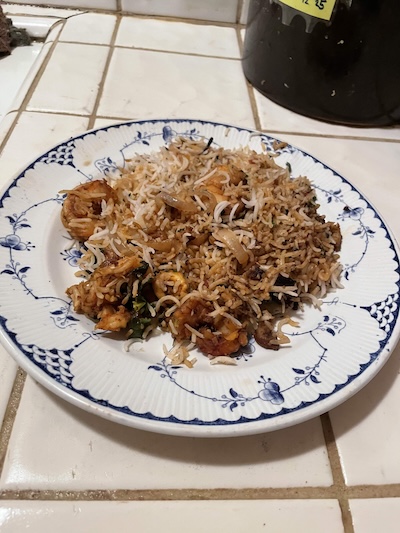
"Biryani" (which means "to fry" in Hindi/Urdu, from the Persian beriyan) is a mixed rice dish from south India, a celebrated cooking styte believed to have been originated during the mediæval Mughal era. This is a quick recipe made in the style of the southern city of Hyderabad.
Yields:
about 6 servings
Time Required:
- 10 mins. prep. time
- 30 min. soaking & marination time
- 40 mins. cooking time
- 80 mins. total time.
Ingredients:
To Marinate Prawns/Shrimps:
- 425 g (15 oz.) prawns or shrimps, after cleaning & de-veining1
- ½ cup2 (120 mL) curd or yoghurt3
- ½ tsp. (3 g) salt (or to taste)
- 1 Tbsp. (9.4 g) turmeric4 (haladar, haldi)
- 1 Tbsp. (11 g) ginger garlic paste5
- 2 tsp. (10 mL) lemon juice
- 2 green chillies6, slit from the middle, and cut into quarters
To Cook Rice:
- 2 cups (380 g) basmati rice7, rinsed, then soaked for 30 mins.
- 9 cups (2.1 L) water (to boil in)
- salt (to taste)
- 2 green cardamom8 (choti elaichi)
- 1 Indian bay leaf9 (tej patta, tamalapatra, tamal patra)
- 2 cloves10 (laung)
- 1 cinnamon11 stick, about 1" (2.5 mm) (dalchini)
To Cook Prawns/Shrimps:
- ¼ cup (60 mL) cooking oil12
- 3 med. onions, sliced
- 2 green cardamom (choti elaichi)
- 1 star anise13, whole, or ½ tsp. (1 g) ground (chakra phool)
- 4 cloves10 (laung)
- 1 Indian bay leaf9 (tej patta, tamalapatra, tamal patra)
- 2 med. tomatoes, finely chopped
- ¼ tsp. (1.5 g) salt
- 1 tsp. (1.8 g) red chili powder, and more per taste
- 2 tsp. (5.2 g) coriander, ground14 (dhaniya)
- 4 tsp. (10 g) biryani masala15
To Layer Biryani:
- ½ cup (120 mL, 8 g) cilantro16 aka coriander leaves, chopped (dhaniya)
- ¼ cup (60 mL, 23 g) mint17, chopped (pudina)
- 1 tsp. (5 mL, 4.7 g) ghee17
- 2 tsp. (10 mL) lemon juice
- 1 tsp. (1.8 g) red chilli powder, added as per taste
- 2 tsp. (5.2 g) coriander, ground (dhaniya)
- 4 tsp. (10 g) biryani masala15
Preparation:
Initial Steps:
Rinse rice 2-3 times, until water runs clear, then soak it in fresh water 30 mins., draining before use. Slice onions, finely dice tamatoes, chop cilantro & mint. Array the spices for use.
Marinate Prawns/Shrimp:
In a bowl, mix yoghurt, salt, turmeric, ginger garlic paste, lemon juice, salt to taste, and green chillies. Add prawns/shrimp, tossing to coat. Cover and refrigerate 15-30 mins.
Cook Rice:
Bring 9 cups (2.1 L) water to boil with salt and whole spices. (A tea/infuser mesh-ball makes removal easier, later.) Add soaked rice. Cook until grains are 80% cooked: When you press a rice grain, it should split but not mash. Drain, and set aside.
Cook Prawns/Shrimp:
Heat oil, in a heavy-bottomed pan. Add sliced onions, fry until deep golden brown. Switch off heat. Drain onions of oil, then remove them to a plate, in preparation for layering the biryani.
In pan with remaining oil, add whole spices, and fry for 20-30 secs. Add diced tomatoes and pinch of salt. Switch on heat. Cook on medium heat, until tomatoes are soft and mushy.
Stir in red chilli powder, ground coriander, and biryani masala. Cook, until the mix19 starts leaving oil at the sides. If mix sticks to pan, add splash of water, and stir.
Add marinated prawns/shrimp. Cook, stirring continuously, until marinade comes to boil. Cook 2-3 mins., until prawns/shrimp start to curl (C-shape); don't overcook. Reduce heat to low. Recommend: Taste the mix here; adjust salt or spice. Once rice is layered, you can't fix it easily.
Layer and Dum-Cook Shrimp/Prawn Biryani:
First layer: Remove half of prawn/shrimp mix to a bowl, for later layering. Atop the remaining half, sprinkle half the fried onions, half the coriander, and half the mint. Layer half the cooked rice. Drizzle 1 tsp. (5 mL, 4.7 g) ghee over rice.
Second layer: Spoon reserve prawn/shrimp mix over rice. Top with (some more, but not all) fried onions, cilantro, and mint.
Third (final) layer: Cover with remaining rice. Sprinkle remaining fried onions, cilantro, mint leaves, and 2 tsp. (10 mL) lemon juice.
Dum cook: Cover pot (heavily weighted enough to seal in steam). Cook on lowest flame for 7 mins. Turn off heat; rest for 5 mins. Serve biryani hot, with raita and salad.
Cook's Notes:
Equipment needed: heavy-bottomed pan, spice grinder, some bowls/plates to hold ingredients & mixes for use, colander, spatula, slotted spoon, and serving plate.
Your cooking will be improved by acquiring a spice grinder, and thereafter buying/storing only whole spices, grinding only as/when needed. Ground spices go flavourless quickly, even in tightly sealed jars.
The whole idea of preparing a "dum biryani", from the Persian dum pukht: "dum" = slow-fired + "pukht" = cooking method, is to tightly seal the cooking vessel and let steam cook and intermix the ingredients. Often in dum cooking (but not here), dough seals cover cooking containers. I use a wide, cast-iron pot with tight, heavy lid.
As talented chef Preeti Nayak's word usage reflects being from North India (and now living in Goa), I've modified and clarified some phrasing for global audiences.
I've included the names of ingredients in Hindi, Urdu, and other languages of India you're likely to encounter in stores, in case it helps find them there (labelled, one hopes, in the Latin alphabet). Specificity can avoid unfortunate errors, as exemplified in the footnote below about Indian bay leaf.
1 If starting with uncleaned prawn/shrip, be aware that removing the shell, legs, and vein will leave about ⅓ left by weight, so plan on 3:1 reduction. Shell/de-vein as per brief tutorial. What makes this a quick biryani is prawn/shrimp's quick cooking.
2 Quarts, pints, cups, tablespoons, teaspoons, and fl. oz. are as defined in US Customary Units, not to be confused with differing British imperial, "legal", "coffee", Commonwealth of Nations, Canadian, Latin American, Japanese, Russian, or Dutch definitions — further proof that everyone needs the metric system.
3 Here in California, "curd" (coagulated and partially fermented milk) doesn't seem to be a commercial product, other then as cottage cheese and (rarely) quark/quarg, farmer cheese, or paneer/ponir, so use just plain regular yoghurt that is neither too thick nor too runny.
4 The rhizomes of turmeric (Curcuma longa), a herbaceous ginger relative native to India and South-East Asia, when boiled, dried, and ground into powder for shelf-stable storage, can add a warm, bitter, black pepper-like flavour and earthy, mustard-like aroma, but is also valued for adding orange-yellow colouring to dishes. In Indian stores, turmeric may be packaged as "haladar" (Hindi) or "haldi" (Urdu).
5 Powdered will do in a pinch. Though grated or ground (fresh) is best, paste is a good compromise.
6 Your choice of chillies will shape the flavour (and spiciness) of this dish. I love serranos, but suggest care in removing the extra-spicy integument and seeds.
7 You might be tempted to substitute a lesser white rice, but don't: You really want to use the highest-quality aged (1, 2) long-grain basmati rice brand from your local Indian grocery store (if you can). LT Foods Ltd.'s Royal "Chef's Secret" is a good example. Locally, it, all spices, fresh cilantro, fresh mint, and ginger garlic paste are available at Namaste Plaza in Belmont.
8 Here's where I unwind the nomenclature mess unfortunately created by modern marketing. True cardamom, the green seed pods and seeds from the plant species Elettaria cardamomum, native to southern India (where it's called "elaichi" in Hindi or rarely "choti (=smaller) elaichi", and "ilaychi" / "elaisi" in Urdu), a member of the ginger family, is a complex, floral, aromatic spice with a sweet flavour reminiscent of eucalyptus/camphor, used in sweet and savoury Indian cuisine (including the beverage masala chai, and desserts like Gulab jamun and kheer), in aromatic rice dishes such as biryanis and pilafs, in spice blends such as garam masala, and in Scandinavian desserts. This is a premium, expensive spice sometimes bleached to create so-called "white cardamom" (which is not a separate thing, just bleached for aesthetic reasons and to give it a milder, less-intense flavour).
By contrast, true cardamom's far less-expensive cousin "black cardamon" uses seeds from a quite different ginger relative, the plant Amomum subulatum, native to Bangladesh. (It's called "badi elaichi" or "kali elaichi" in Hindi, "bara elaichi" or "purbi elaichi" in Urdu, "baṛo elāca" in Bengali.) It has a very different flavour profile: Its seeds are roasted (and the pods then discarded) to give them a stronger, smoky flavour with menthol notes, making it more common to use in savoury dishes (like soups, stews, curries, and strongly flavoured biryanis), and as a component of smoky spice blends and curry pastes. It's also used in Indian dal (split, dried lentil or other pulses, from the Sanskrit verb root "dal-" = to split) soup and certain Chinese dishes, where its strong, smoky flavour complements other ingredients. You would not use it in desserts or breads, or any sweet dish.
It's thus important to not confuse the two spices. If your mass-market "cardamom" of unspecified subvariety consists of dark brown seeds, that may be black cardamom. Unfortunately, seeds from green cardamom pods, once removed from them, also look dark brown/black, so the two may be indistinguishable except by taste. (For reasons given in a prior footnote, in that case I'd say junk the seeds or, worse, ground cardamom and start over, perhaps buying quality whole pods from Penzey's Spices.)
9 Indian bay leaf aka malabathrum (Cinnamomum tamala), "tej patta" in Hindi, is from a laurel family member native to northern India, Bangladesh, Nepal, Myanmar, Laos, Vietnam, and south-western China, giving a strong cinnamon-like aroma and taste to dishes. You should not use Greek aka Turkish laurel (bay) tree leaf, Laurus nobilis, nor its New World cousin, the California Bay Laurel tree (Umbellularia californica): All three are kin, but Indian bay leaf is distinctive and should be used, here. Indian bay leaves can be distinguished visually from others by having three veins, vs. others' single veins.
Recipes from India & nearby lands are often unintentionally misleading to cooks in the West, saying only "bay leaf" and trusting to the reader to understand Indian bay leaf being the implied meaning. I've amended all such recipes in my collection, to clarify.
10 Cloves are flower buds of a tree, Syzygium aromaticum, in the myrtle family, native to Indonesia's Molucca ("Spice") Islands, used in many cuisines for their distinctive taste and aroma: intense, pungent, and "warm"-tasting.
11 After a lifetime of not knowing one cinnamon from another, I learned that true cinnamon comes only from the inner bark of the "Cinnamonum verum" tree native to Sri Lanka, and has milder, more interesting, citrusy flavour compared to bulk, grocery-store cinnamon, which is made from cheaper, harsher-tasting non-verum Cinnamonum species grown largely in southern China, Vietnam, and India, and which technically isn't cinnamon at all, but rather is properly called cassia.
12 Olive oil works great for this, but select to taste.
13 Star anise is the star-shaped fruit of medium-sized evergreen tree Illicium verum, native to South China and north-east Vietnam, that resembles in flavour anise, seed of an unrelated plant, Pimpinella anisum, native to the eastern Mediterranean region and South-West Asia. Star anise, in Hindi "chakra phool" (star flower) is used in a variety of cuisines and in the famous "five-spice powder" of southern China.
14 Learn from my mistake: Even though I've owned a spice grinder for years, my first time baking hvetekake (Norwegian sweet cardamom bread), I relied on years-old ground cardamom in my spice rack, which turned out to be nearly tasteless, as quickly happens to ground spices even in tightly sealed jars, whereas whole spice doesn't start to lose potency for at least six months to a year for green cardamom pods, twice that for black cardamom ones.
Before grinding cardamom, apply pressure on the pods, on a cutting board, to split the pods and release the small seeds by pressing with a chef's knife or the back side of a spoon, which will be the part you grind (omitting husks).
15 I use author Preeti Nayak's recipe for home-made biryani masala ("masala" meaning spice mix), and keep a jar of it in my freezer.
16 The original recipe said "coriander leaves", which is standard British English: Americans call only the seeds "coriander", calling the leaves "cilantro", the Spanish word for coriander.
17 Frozen cilantro and dried mint can also work, if you can't get fresh. Locally, I grow spearmint in my garden, and can get cilantro any time at Mexican markets. Even if you're a terrible gardener, try growing mint anyway. It's unbelievably hardy.
18 Ghee is butter melted to separate and filter out whey and milk solids (aka "clarified butter"), something very easy to do at home, resulting in a wonderful nutty, rich-tasting substance you can store at room temperature, that also doesn't burn when used cooking oil. Its inclusion does improve this dish.
19 I've changed the original recipe's term "masala" to "mix" to reduce confusion, given that "biryani masala" is a listed ingredient, but, in Hindi, "masala", from the Sanskrit maṣi, to mash or powder/grind to powder, does merely mean mix.
Taken from: https://theyummydelights.com/prawn-biryani-shrimp-biryani-recipe/. (That page's copyright notice is toothless as to the recipe itself, having force concerning only non-recipe elements such as photos.)
Collected and re-published at http://linuxmafia.com/~rick/recipes/shrimp-biryani.html by Rick Moen <rick@linuxmafia.com> on Mar. 1, 2026. Individual recipes are free from copyright. Share and enjoy!
(If I have any copyright title in my own very minor contributions to this page — not my intention — they were created in 2026 by Rick Moen <rick@linuxmafia.com> and licensed for use under CC0. I have thereby waived all copyright, compilation copyright, and related or neighbouring rights to this work. This work is published from: United States of America.) The image file (photograph) was taken on Mar. 1, 2021, by Rick Moen and licensed for use under CC0.