Biryani Masala
Recipe from Preeti Nayak
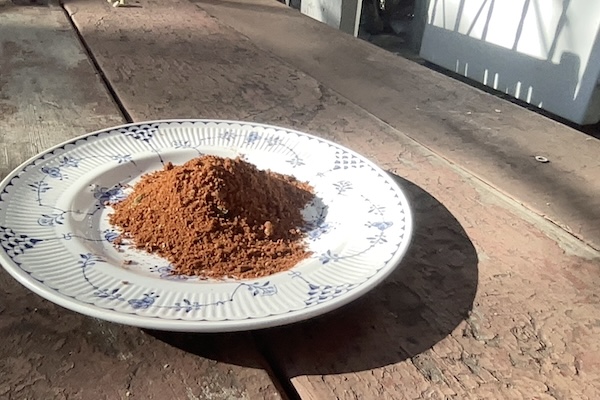
This is a masala (spice mix), in ground powder form1, tailored for use in any "biryani", a mixed rice dish slow-cooked in a celebrated south India style — also adaptable to other uses, such as in curries and in pulav/pulao.
Home-made masalas are far superior to any prepared, store-bought spice mix, quick & easy to make, cost-effective, free of preservatives, can be modified to taste, and allow you to be certain of all ingredients.
Yields:
about 1 cup2 (95 g)
Time Required:
- 5 mins. prep. time
- 10 mins. cooking time
- 15 mins. total time.
Ingredients:
For Main Preparation:
- 1 Tbsp. (7.3 g) caraway seeds3 (shahi jeera)
- 1 Tbsp. (6.8 g) cumin seeds4 (jeera)
- 3 Tbsp. (12 g) coriander seeds5 (dhaniya)
- 1 Tbsp. (6.5 g) fennel seeds6 (saunf)
- 35 black peppercorns7 (kali mirch)
- 1 cinnamon8 stick, about 1" (dalchini)
- 3 black cardamom9 (badi elaichi, masala elaichi)
- ½ nutmeg10 (jaiphal)
- 15 green cardamom9 if large; 20 if small (choti elaichi)
- 1 ½ mace10 (javitri)
- 2 star anise11 (chakra phool)
- 8 black stone flower12 (pathat ke phool / patthar ke phool, biryani phool, dagad phool, kalpasi)
- 18 cloves13 (laung)
- 5-6 dried red chillies
- 9 Indian bay leaves14 if small; 5-6 if large (tej patta
- 1 Tbsp. (8 g) garlic powder
- ½ tsp. (1.2 g) turmeric15 (haladar, haldi)
- 1 Tbsp. (6.7 g) Kashmiri red chilli powder16; use no other (Kashmiri laal mirch)
- 1 Tbsp. (0.7 g) dried fenugreek leaves (not seeds!)17 (kasuri methi)
Added at End:
- 12-15 (whole) green cardamom9
- 2 Indian bay leaves14 (reserved from roasting 9 listed above) (tej patta, tamalapatra, tamal patra)
Preparation:
Clean assembled whole spices of debris, stones, or husks — especially cumin, coriander, fennel, and caraway seeds. Ensure spices are fresh.
On low heat, dry roast Indian bay leaves, stirring continuously until aromatic and crisp. To check if they are ready, crush a leaf between your palms: If it crushes easily, they're done. Reserve 2 roasted Indian bay leaves; set aside for later use. Transfer remaining Indian bay leaves to a plate.
Dry roast caraway seeds, cumin, coriander seeds, fennel seeds, black peppercorns, cinnamon stick, black cardamom, nutmeg, green cardamom, mace, star anise, black stone flower, cloves, and dried red chillies, over low heat until lightly golden and fragrant. Don't let them over-fry or turn dark brown; that means spices are burnt. Switch off heat.
Add dried fenugreek leaves to pan. Let roast on leftover heat, stirring for 1 min. Remove all roasted spices to a plate.
Let roasted spices cool completely, before transfer to grinder. Add garlic powder, turmeric, and Kashmiri red chilli powder, then grind everything to coarse powder. Use short pulses: This prevents the machine from overheating, and preserves spices' aroma and flavor.
Finally, crush reserved roasted Indian bay leaves, and add to the mix18 along with the (whole) green cardamom.
Author's Notes:
Usage in Biryanis: Add 2 Tbsp. (17 g) biryani masala, first as 1 Tbsp. (8.5 g) for marinating the chicken/mutton, then ½ Tbsp. (4.2 g) added to the biryani gravy and ½ Tbsp. (4.2 g) sprinkled while layering the biryani rice. This is for 1 kg (2.2 lb) chicken or mutton.
Usage in Curries: Add 1 Tbsp. (8.5 g) biryani masala to chicken or mutton curries for rich, aromatic gravy. Taste; add more to taste.
Usage in Pulav/Pulao: Add 1 tsp. (2.8 g) to vegetable or chicken pulav/pulao, to add flavour depth.
Store container in a cool, dry place: Stays good for a month. For longer shelf life, freezer storage extends that to 3 months. Make sure spoon used to dispense masala is dry.
Cook's Notes:
Equipment needed: spice grinder or blender. Airtight container to receive masala. Heavy-bottom cooking pan. Tongs. Several clean plates.
Your cooking will be improved by acquiring a spice grinder, and thereafter buying/storing only whole spices, grinding only as/when needed. Ground spices go flavourless quickly, even in tightly sealed jars.
I've included the names of ingredients in Hindi, Urdu, and other languages of India you're likely to encounter in stores, in case it helps find them there (labelled, one hopes, in the Latin alphabet). Specificity can avoid unfortunate errors, as exemplified in the footnote below about Indian bay leaf.
1 Learn from my mistake: Even though I've owned a spice grinder for years, my first time baking hvetekake (Norwegian sweet cardamom bread), I relied on years-old ground cardamom in my spice rack, which turned out to be nearly tasteless, as quickly happens to ground spices even in tightly sealed jars, whereas whole spice doesn't start to lose potency for at least six months to a year for green cardamom pods, twice that for black cardamom ones.
Before grinding cardamom, apply pressure on the pods, on a cutting board, to split the pods and release the small seeds by pressing with a chef's knife or the back side of a spoon, which will be the part you grind (omitting husks).
2 Quarts, pints, cups, tablespoons, teaspoons, and fl. oz. are as defined in US Customary Units, not to be confused with differing British imperial, "legal", "coffee", Commonwealth of Nations, Canadian, Latin American, Japanese, Russian, or Dutch definitions — further proof that everyone needs the metric system.
3 Caraway "seeds" aren't seeds, but rather small fruit, from a carrot/parsley-family plant (Carum carvi), native to western Asia, Europe, and North Africa, and related to cumin. Thus the plant's alternate names: Persian cumin and meridian fennel. It's been used to add a pungent, earthy, anise-like flavour and aroma to a wide range of food since ancient times, and is often used as a spice in breads, especially rye-based breads.
We Scandinavians also use it in akvavit.
Its name is derived from the Arabic al-karawiya (ﻙﺭﺍﻮﻳﺓ), which probably also arrived in European languages as "cumin". The plant is believed to have originated in Asia Minor (modern-day Türkiye). In Indian groceries, you may find caraway as "shah jeera", which is Hindi derived from Persian (aka "shahi zeera" in Urdu), meaning "royal cumin". And in fact "jeera" without modifier is Hindi for cumin, the dried seed of a different plant (Cuminum cyminum) in the same carrot/parsley family, native to central & west Asia.
Not that readers would, but never harvest for eating purposes any wild member of the "Apiaceae" carrot/parsley family, as that includes some of the most poisonous plants on earth, and live-off-the-land people who get it wrong tend to die.
4 Cumin's the dried seeds of a flowering plant (Cuminum cyminum) with a distinctive flavour and aroma, in the carrot/parsley family, likely originating in Central Asia, South-western Asia, or the Eastern Mediterranean. It's used in many cuisines, whole or ground, and is called "jeera" in Hindi/Urdu.
5 Coriander's the dried seeds of a flowering plant (Coriandrum sativum) with a distinctive flavour and aroma, in the carrot/parsley family, originating in the Mediterranean basin. In US English only, the stems and leaves are named "cilantro", the Spanish word for coriander. Most perceive the leaves as having a fresh, citrusy taste, but a minority (owing to genetic difference) perceive those as soapy or otherwise bad. Coriander's called "dhaniya" in Hindi/Urdu.
6 Fennel's the dried seeds of a flowering plant (Foeniculum vulgare) with anise-like taste, in the carrot/parsley family, originating along the Mediterranean shore. Fennel's called "saunf" in Hindi/Urdu.
7 Black pepper's the seed of a flowering, woody vine (Piper nigrum) native to South-east or South Asia, one of the world's most popular spices, not to be confused with long peppers, Sichuan peppers, or chilli peppers, all of which are differently spicy. Black pepper's called "kali mirch" (dark pepper) in Hindi/Urdu.
8 After a lifetime of not knowing one cinnamon from another, I learned that true cinnamon comes only from the inner bark of the "Cinnamonum verum" tree native to Sri Lanka, and has milder, more interesting, citrusy flavour compared to bulk, grocery-store cinnamon, which is made from cheaper, harsher-tasting non-verum Cinnamonum species grown largely in southern China, Vietnam, and India, and which technically isn't cinnamon at all, but rather is properly called cassia.
9 Here's where I unwind the nomenclature mess unfortunately created by modern marketing. True cardamom, the green seed pods and seeds from the plant species Elettaria cardamomum, native to southern India (where it's called "elaichi" in Hindi or rarely "choti (=smaller) elaichi", and "ilaychi" / "elaisi" in Urdu), a member of the ginger family, is a complex, floral, aromatic spice with a sweet flavour reminiscent of eucalyptus/camphor, used in sweet and savoury Indian cuisine (including the beverage masala chai, and desserts like Gulab jamun and kheer), in aromatic rice dishes such as biryanis and pilafs, in spice blends such as garam masala, and in Scandinavian desserts. This is a premium, expensive spice sometimes bleached to create so-called "white cardamom" (which is not a separate thing, just bleached for aesthetic reasons and to give it a milder, less-intense flavour).
By contrast, true cardamom's far less-expensive cousin "black cardamon" uses seeds from a quite different ginger relative, the plant Amomum subulatum, native to Bangladesh. (It's called "badi elaichi" or "kali elaichi" in Hindi, "bara elaichi" or "purbi elaichi" in Urdu, "baṛo elāca" in Bengali.) It has a very different flavour profile: Its seeds are roasted (and the pods then discarded) to give them a stronger, smoky flavour with menthol notes, making it more common to use in savoury dishes (like soups, stews, curries, and strongly flavoured biryanis), and as a component of smoky spice blends and curry pastes. It's also used in Indian "dal" (split, dried lentil or other pulses, from the Sanskrit verb root "dal-" = to split) soup and certain Chinese dishes, where its strong, smoky flavour complements other ingredients. You would not use it in desserts or breads, or any sweet dish.
It's thus important to not confuse the two spices. If your mass-market "cardamom" of unspecified subvariety consists of dark brown seeds, that may be black cardamom. Unfortunately, seeds from green cardamom pods, once removed from them, also look dark brown/black, so the two may be indistinguishable except by taste. (For reasons given in a prior footnote, in that case I'd say junk the seeds or, worse, ground cardamom and start over, perhaps buying quality whole pods from Penzey's Spices.)
10 Nutmeg's the seed of any of several evergreen tree species of the genus Myristica and native to the Bandu Islands, Indonesia, the ideal being true aka fragrant nutmeg (Myristica fragrans), with a distinctive pungent fragrance and warm, slightly sweet taste. Less preferred are M. malabarica and M. argentea. Mace is a spice made from the reddish seed covering (aril) of nutmeg seeds. Its flavour is similar to that of nutmeg, but more delicate.
11 Star anise is the star-shaped fruit of a medium-sized evergreen tree (Illicium verum), native to South China and north-east Vietnam, that resembles in flavour anise, seed of an unrelated plant (Pimpinella anisum), native to the eastern Mediterranean region and South-West Asia. Star anise, in Hindi "chakra phool" (star flower) is used in a variety of cuisines and in the famous "five-spice powder" of southern China.
12 Black stone flower is a leafy (foliose) lichen (Parmotrema perlatum) of uncertain origin used as a spice in Indian cuisine, not for its flavour directly, but rather for releasing an earthy fragrance and taste when cooked in oil or butter. As noted in the footnote about star anise, "phool" in Hindi/Urdu means flower, thus some of its names: "Patthar ke phool" means stone flower. "Dagad phool" means ruffled flower. "Kalpasi" is a compound word in Tamil, where "kal" is stone and "paasi" is light green moss.
13 Cloves are flower buds of a tree (Syzygium aromaticum) in the myrtle family, native to Indonesia's Molucca ("Spice") Islands, used in many cuisines for its distinctive taste and aroma: intense, pungent, and "warm"-tasting.
14 Indian bay leaf aka malabathrum (Cinnamomum tamala), "tej patta" in Hindi, is from a laurel family member native to northern India, Bangladesh, Nepal, Myanmar, Laos, Vietnam, and south-western China, giving a strong cinnamon-like aroma and taste to dishes. You should not use Greek aka Turkish laurel (bay) tree leaf, Laurus nobilis, nor its New World cousin, the California Bay Laurel tree (Umbellularia californica): All three are kin, but Indian bay leaf is distinctive, and should be used, here. Indian bay leaves can be distinguished visually from others by having three veins, vs. others' single veins.
Recipes from India & nearby lands are often unintentionally misleading to cooks in the West, saying only "bay leaf" and trusting to the reader to understand Indian bay leaf being the implied meaning. I've amended all such recipes in my collection, to clarify.
15 The rhizomes of turmeric (Curcuma longa), a herbaceous ginger relative native to India and South-East Asia, when boiled, dried, and ground into powder for shelf-stable storage, can add a warm, bitter, black pepper-like flavour and earthy, mustard-like aroma, but are also valued for adding orange-yellow colouring to dishes. In Indian stores, turmeric may be packaged as "haladar" (Hindi) or "haldi" (Urdu). The powder keeps well; the rhizomes are only rarely bought fresh.
16 Kashmiri red chillies are a cultivar of New World chilli pepper (Capsicum annuum), bred and used for adding a bright red colour to food. They are very mild (about ⅕ a Jalapeno's spiciness), but with a pleasant aroma, and often used in tandooris, pickles & chutneys, rogan josh, etc. Most is now sourced outside Kashmir, owing to high demand, and substitutes such as Byadagi chillies are often used. "Mirch" is the name for chillies in Hindi/Urdu, and "laal" means red.
17 Fenugreek's a semi-arid annual crop plant (Trigonella foenum-graecum) grown worldwide to use its seeds and leaves in Indian, Armenian, Iranian, Arab, Jewish, Turksih, and Georgian cooking. It adds mild spiciness and a bold, savoury note to dishes, which can be described as celery and fennel, overlaid with the aroma and mild flavour of maple syrup. Fenugreek's called "methi" in Hindi/Urdu. "Kasuri" means originating from the Kasur region, in Punjab, but in this context implies sun-drying, which reduces bitterness.
18 Here, I've changed the original recipe's term "masala" to "mix" to reduce confusion. For the record, in Hindi/Urdu "masala" (from the Sanskrit maṣi, to mash or powder/grind to powder) merely means mix.
Taken from: https://theyummydelights.com/biryani-masala-powder-recipe/. (That page's copyright notice is toothless as to the recipe itself, having force concerning only non-recipe elements such as photos.)
Collected and republished at http://linuxmafia.com/~rick/recipes/biryani-masala.html by Rick Moen <rick@linuxmafia.com> on Mar. 3, 2026. Individual recipes are free from copyright. Share and enjoy!
(If I have any copyright title in my own very minor contributions to this page — not my intention — they were created in 2026 by Rick Moen <rick@linuxmafia.com> and licensed for use under CC0. I have thereby waived all copyright, compilation copyright, and related or neighbouring rights to this work. This work is published from: United States of America.) The image file (photograph) was taken on Mar. 3, 2026, by Rick Moen and licensed for use under CC0.