Sweet Cardamom Bread (Hvetekake)
Recipe from Astrid Ingeborg Karlsen Scott
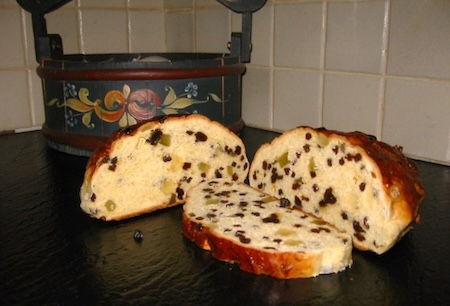
Hvetekake ("wheat cake") is an aromatic, sweet bread my immigrant Norwegian family and other Scandinavian ethnics cook, especially in the Christmas season (giving it its other name, "Julekake" = Christmas cake, though that name also applies to other Christmas breads), the cardamom giving it its characteristic aroma and flavour. The dough is traditionally formed into round loaves, and the bread is often served warm with gjetost1, a sweet, caramel-coloured Norwegian goat cheese. It also does well with other mild cheeses or preserves.
Yields:
2 round loaves
Time Required:
- 50 mins. prep. time
- 2 hrs. rising time
- 40-45 mins. baking time
Ingredients:
- 4 ½ tsp.2 (or two envelope pkgs.) active dry baker's3 yeast
- 2 ½ cups (590 mL) milk, warmed
- 3 Tbsp. (45 mL) butter4, melted
- 4 ¾ cup (570 g)5 all-purpose flour
- ⅓ cup (66 g) sugar
- 1 ½ tsp. (9 g) salt
- 1 ½ tsp. (3 g) cardamom6, freshly ground7
- Butter8, melted
Preparation:
Preheat oven to 450°F (230°C).
In a large bowl, mix yeast, milk, and butter, stirring until yeast is dissolved. Stir in 3 ½ - 3 ¾ cups (420 - 450 g) of the flour, sugar, salt, and cardamom mix. Beat batter until glossy. Add 1 cup (120 g) more flour. The dough will be very soft. Cover, and let rest 15 mins.
Turn dough out onto a lightly floured surface, and knead until elastic and glossy, 8-10 mins., adding additional flour if needed. Lightly grease the bowl, and return the dough to it, turning once. Let rise in a draft-free, warm place until doubled in bulk, about 1 hr.
Punch down. Turn dough out onto a lightly floured board, using as little flour as possible. Divide into two parts, and shape into round loaves.
Place onto baking sheets covered with parchment paper, or dust lightly with flour, but do not grease the baking sheets. Set to rise in a draft-free, warm place until almost (again) doubled in bulk.
Preheat oven to 375°F (190°C). Brush with melted butter6, and bake until done with a golden colour, about 40-45 mins. Remove to cooling racks, and brush with butter once more. Breads are done cooling when they sound hollow if tapped on the bottom.
Cook's Notes:
Hvetekake recipes often add mixed candied fruit (especially diced, candied citron fruit aka "succade"), almonds, and/or raisins into the batter as a further festive touch.
I recommend cutting two slits in the top of each loaf, before baking, and using the oven's bottom shelf.
Hvetekake is well suited for freezing.
Your cooking will be improved by acquiring a spice grinder, and thereafter buying/storing only whole spices, grinding only as/when needed. Ground spices go flavourless quickly, even in tightly sealed jars.
1 "Gjetost" means "goat cheese" ("gjet" = goat, in old Norwegian spelling, + "ost" = cheese), but the typical cheese so designated is made from both cow and goat milk, to add some goat-milk tangy flavour. ("Gjetost" is also spelled "geitost", using current spelling "geit" for "goat".) Cheese made from only goat milk would be labelled "ekte gjetost" (true goat cheese). Both are sub-varieties of "brunost" ("brown cheese"), the beloved, iconic, sweet Norwegian boiled-and-carmelised whey that is not technically a cheese, but used the same way. If lactose-intolerant, be aware all brunost is inherently lactose-rich.
2 Quarts, pints, cups, tablespoons, teaspoons, and fl. oz. are as defined in US Customary Units, not to be confused with differing British imperial, "legal", "coffee", Commonwealth of Nations, Canadian, Latin American, Japanese, Russian, or Dutch definitions — further proof that everyone needs the metric system.
3 Active dry baker's yeast is a strain bred for baking. Even though it's the same yeast species (Saccharomyces cerevisiae) underlying "brewer's yeast" (bred for fermenting wine/beer), don't confuse them, as there are differences.
Forms other than "active dry" exist, such as a gimmicky variant called "rapid rise" that is of dubious worth, but non-commercial bakers should generally stick with "active dry", as it has the best mix of longevity (will remain viable for years in the refrigerator, and more than a decade frozen) and versatility. On the other hand, the variant called "instant" (active dry) baker's yeast has a finer texture and requires less rising time, and is great for baking if you have it. (It's more perishable, but quicker-acting and doesn't require rehydration and proofing before use.)
For baking, avoid "deactivated" yeast, meaning killed yeast, because it has no leavening value. It's used as a food additive and component of cheese substitutes. Deactivated brewer's yeast, gleaned from brewing, is sometimes sold as a similar food product.
4 Astrid's original recipe called for margarine, but I hope we can get past that 1970s nutrition mistake, and use real butter again.
5 Astrid's original recipe said "11 ¾ dL" (= 1175 mL) as the metric equivalent. To be friendly to cooks outside North America, I also try to provide metric quantities, in addition to US Customary Units like "cups", but the proper SI (metric) unit for dry cooking ingredients is grams ("g"). By contrast, mL = 1/1000 of a litre (or, less frequently, "dL" = 1/10 of a litre) is proper only for liquid ingredients. Therefore, I've corrected Astrid's well-intentioned but suboptimal attempt at metrication.
Flours and similar dry ingredients should be spooned into measuring cups and then levelled, not packed into the cups, which impairs measuring accuracy.
6 Here's where I unwind the nomenclature mess unfortunately created by modern marketing. True cardamom, the green seed pods and seeds from the plant species Elettaria cardamomum, native to southern India (where it's called "elaichi" in Hindi, and "ilaychi" / "elaisi" in Urdu), a member of the ginger family, is a complex, floral, aromatic spice with a sweet flavour reminiscent of eucalyptus/camphor, used in sweet and savoury Indian cuisine (including the beverage masala chai, and desserts like Gulab jamun and kheer), in aromatic rice dishes such as biryanis and pilafs, in spice blends such as garam masala, and in Scandinavian desserts. This is a premium, expensive spice sometimes bleached to create so-called "white cardamom" (which is not a separate thing, just bleached for aesthetic reasons and to give it a milder, less-intense flavour).
By contrast, true cardamom's far less expensive cousin "black cardamom" uses seeds from a quite different ginger relative, the plant Amomum subulatum, native to Bangladesh. (It's called "badi elaichi" or "kali elaichi" in Hindi, "bara elaichi" or "purbi elaichi" in Urdu, "baro elāca" in Bengali.) It has a very different flavour profile: Its seeds are roasted (and the pods then discarded) to give them a stronger, smoky flavour with menthol notes, making it more common to use in savoury dishes (like soups, stews, curries, and strongly flavoured biryanis), and as a component of smoky spice blends and curry pastes. It's also used in Indian dal (split, dried lentil or other pulses, from the Sanskrit verb root "dal-" = to split) soup and certain Chinese dishes, where its strong, smoky flavour complements other ingredients. You would not use it in desserts or breads, or any sweet dish.
It's thus important to not confuse the two spices. If your mass-market "cardamom" of unspecified subvariety consists of dark brown seeds, that may be black cardamom, exactly the wrong thing for this dish. Unfortunately, the seeds from green cardamom pods, once removed from them, also look dark brown/black, so the two may be indistinguishable except by taste. (For reasons given in the next footnote, in that case I'd say junk the stuff and start over, perhaps buying a quality replacement from Penzey's Spices.)
7 Learn from my mistake: Even though I've owned a spice grinder for years, my first time baking hvetekake, I relied on years-old ground cardamom in my spice rack, which turned out to be nearly tasteless, as quickly happens to ground spices even in tightly sealed jars, whereas whole spice doesn't start to lose potency for at least six months to a year for green cardamom pods, twice that for black cardamom seeds.
Before grinding green cardamom, apply pressure on the pods, on a cutting board, to split the pods and release the small seeds by pressing with a chef's knife or the back side of a spoon, which will be the part you grind (omitting the husks). To produce 1 tsp. (2 g) ground green cardamom, start with about 8-10 pods. (If grinding less than that, a mortar & pestle works much better than does a spice grinder.)
8 How much melted butter? Maybe 2 Tbsp. (30 mL), but judge for yourself. Note that two application steps are specified. (Some hvetekake recipes have you use a beaten egg to brush the bread, instead, which I'm sure is also good.)
Taken from: Authentic Norwegian Cooking ("Ekte Norsk Mat") by Astrid Ingeborg Karlsen Scott (1936-2017), 2002 hardcover, published by Nordic Adventures (and other publishers over the years), a fabulous collection of over 300 truly great Norwegian recipes by a celebrated, Oslo-born Norwegian-American chef. (That book's copyright notice is toothless as to recipes themselves, having force concerning only non-recipe elements such as photos.)
Collected and re-published at http://linuxmafia.com/~rick/recipes/sweet-cardamom-bread.html by Rick Moen <rick@linuxmafia.com> on Dec. 20, 2025. Individual recipes are free from copyright. Share and enjoy!
(If I have any copyright title in my own very minor contributions to this page — not my intention — they were created in 2025 by Rick Moen <rick@linuxmafia.com> and licensed for use under CC0. I have thereby waived all copyright, compilation copyright, and related or neighbouring rights to this work. This work is published from: United States of America.)
Image (used, here, unmodified) is Copyright © Jun. 11, 2009 by Art Anderson, who licensed it for use under CC-BY-SA-3.0 Unported. My thanks for Art's generosity.

(Reminder: Creative Commons licences before v. 4.0, other than CC0, suffer an exploitable defect, and should not be used for new works. Republishers of works under the obsolete, defective licences should take care to make no mistakes in attribution, or risk being shaken down by a copyright troll.)