Hyderabadi Chicken Biryani
Recipe from Dr. Roxana Begum
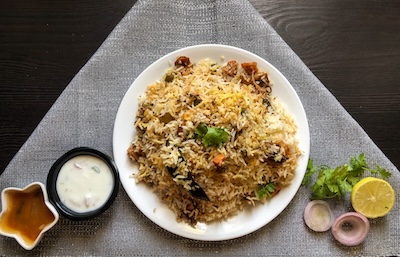
"Biryani" (which means "to fry" in Hindi/Urdu, from the Persian beriyan) is a mixed rice dish from south India, a celebrated cooking styte believed to have been originated during the mediæval Mughal era. Of that style of dish, this example with aromatic saffron-flavoured basmati rice, from the southern city of Hyderabad, is the very most famous.
Yields:
about 8 servings
Time Required:
- 30 mins. prep. time
- 3 to 5 hrs. marination time
- 60 mins. cooking time
Ingredients:
Fried Onions:
Chicken w/ Marinade:
- 1 ½ lb. (680 g) chicken with bone3, cut and cleaned4 (avoid chicken breast)
- ⅔ to ¾ cup (350 to 525 mL) yoghurt, plain5 (qty. as needed)
- 1 ½ Tbsp. (12 g) ginger garlic paste, or grated6 ginger and garlic
- 1 tsp. (6 g) salt (adj. to taste)
- 1 tsp. (3 g) chilli powder
- ½ tsp. (1 g) turmeric7, ground
- 1 chilli pepper (jalapeno, serrano, or cayenne), adj. to taste
Spices8 for Marinade:
- 1 cinnamon9 stick
- 1 black cardamom10
- 5 green cardamom10
- 5 cloves11
- 1 Indian bay leaf12, large
- 1 tsp. (2 g) shah jeera (caraway seeds)13
- ½ tsp. (2.5 g) pepper, ground
Biryani Rice:
- 2 cups (475 mL) basmati14 rice, aged long grain
- 1 ¼ Tbsp. (21 g) salt
- 2 Tbsp. (30 mL) cooking oil, left over from frying onions
- ¼ cup (60 mL) cilantro15, fresh chopped
- 2 Tbsp. (30 mL) mint15, fresh chopped
- 2 Tbsp. (30 mL) lemon juice
- 1 tsp. (0.5 - 1 g) saffron16, ground and dissolved in 2 Tbsp. (30 mL) hot water
- 2 Tbsp. (30 mL) ghee17 (recommended, optional)
Whole Spices for Rice:
Preparation:
Fry Onions
Optionally for speed and crispness of frying, sprinkle some flour (or corn starch (US/Canada) aka cornflour (UK/other), or rice flour plus corn starch) onto onion slices, before frying.
Heat oil to medium high, in a wide frying pan. If you place your palm about 3" (8 cm) over oil surface, you should feel the heat.
Fry onions in batches. Don't crowd the pan. Fry until crisp light golden brown. Don't let onion slices turn soggy or dark brown. Set aside: Drain onions on paper towels. (Save the oil.)
Marinate Chicken
In a spice grinder, process spices (except Indian bay leaf) for marinade, until fine powder. In large mixing bowl, combine chicken with all marinade ingredients (including Indian bay leaf, cinnamon stick, black & green cardamom, and cloves), and ⅓ of fried onions. For yoghurt, start with ½ cup (120 mL); increase as needed to ¾ cup (180 mL). The mixture should be thick, and not runny.
Marinate 3 - 5 hrs.
Cook Rice
Rinse rice, 4 or 5 times, in lots of water, until clear. Drain well. Soak ⅓ cup (80 mL) basmati rice in water, for 1 hr.18 Save the rest for next step.
In a large cooking pot, boil 6 cups (1.4 L) of water with 1 ¼ Tbsp. (21 g) salt, 1 Tbsp. (15 mL) cooking oil, and whole spices.19 Add rice, and cook at medium-high to high heat, until grains are soft but al dente, like pasta, about 4 - 5 mins., gently stirring. Drain rice in a colander, and set aside.
Optionally, drizzle rice with ghee, to take your biryani up a notch.
Assemble Rice & Chicken Layers
Scoop out & discard any watery liquid on marinade surface. Transfer chicken with marinade to a wide, oven-proof cooking pot (10" = 25 cm diameter). Tip: Chicken should be lightly coated with marinade. Too much marinade can make rice soggy.
Top marinated chicken with cilantro, mint, 1 Tbsp. (15 mL) lemon juice, ½ Tbsp. (7.5 mL) cooking oil, and most of remaining fried onions. Drain soaked basmati rice very well, and spread over fried onions. This raw soaked rice will get cooked with chicken juices.
Next, layer remaining (par-boiled) rice. Top with remaining lemon juice, saffron water, fried onions, and ghee. Tip: If you prefer, pick out whole spices from cooked rice, before steaming.
Place one sheet of parchment paper, followed by two sheets aluminum foil, over cooking pot.20 Place lid tight, for a good seal.
Steam the Dish
Bake biryani in a preheated oven at 350°F (180°C) for 1 hr., until steam builds up well. Chicken should be well done, juicy, and falling off the bone.
Serve
Remove from oven. Let cool five mins., then gently mix rice and chicken, and remove the Indian bay leaf. Using spatula, mound now-complete biryani onto serving plate, making sure to present rice in various colours — white, yellow, orange, and brown. Place some chicken pieces on top. Scatter fried onions, herbs, and extra saffron rice on top, also.
(Optionally:) Serve with mirchi ka salan and raita.
Cook's Notes:
Equipment needed: wide frying pan, several mixing bowls, spice grinder, colander, 5 qt. 10" (25 cm) diameter oven-proof cooking pot, spatula, parchment paper, aluminum foil, and serving plate. A sifter, if dusting onion slices with flour.
Your cooking will be improved by acquiring a spice grinder, and thereafter buying/storing only whole spices, grinding only as/when needed. Ground spices go flavourless quickly, even in tightly sealed jars.
Dr. Begum stresses that "optimal amount of salt and oil is very important. If everything else is perfect, but you don't use right amount of salt, that alone can ruin the taste of biryani. I use a minimum of 2 Tbsp. (30 mL) oil per cup (235 mL) of raw rice, as there are additional ingredients — chicken, onions, etc."
I've simplified Dr. Begum's recipe to remove two variant cooking paths, first an option to cook rice in rice cooker (easiest way to achieve fluffy rice), instead of in cooking pot (as above), second a later option to steam the assembled biryani on stove-top, instead of in oven (as above).
I've included the names of ingredients in Hindi, Urdu, and other languages of India you're likely to encounter in stores, in case it helps find them there (labelled, one hopes, in the Latin alphabet). Specificity can avoid unfortunate errors, as exemplified in the footnote below about Indian bay leaf.
1 Quarts, pints, cups, tablespoons, teaspoons, and fl. oz. are as defined in US Customary Units, not to be confused with differing British imperial, "legal", "coffee", Commonwealth of Nations, Canadian, Latin American, Japanese, Russian, or Dutch definitions — further proof that everyone needs the metric system.
2 Dr. Begum recommends peanut oil (for its high smoke point). Personally, I prefer and use avocado oil, which has a higher smoke point and is better nutritionally, and the same is true of ghee (clarified butter).
3 Chicken pieces with bones left in yield the most flavour, but breast pieces become too dry. Best choices for this recipe are leg and thigh pieces, particularly if doing this boneless.
4 Cleaning (rinsing) chicken seems a wise precaution against food contamination.
5 Dr. Begum warns against "Greek"-style: "Just plain regular yoghurt that is neither too thick nor too runny.
6 Powdered will do in a pinch, but grated or ground (fresh) is simply better.
7 The rhizomes of turmeric (Curcuma longa), a herbaceous ginger relative native to India and South East Asia, when boiled, dried, and ground into powder for shelf-stable storage, can add a warm, bitter, black pepper-like flavour and earthy, mustard-like aroma, but is also valued for adding orange-yellow colouring to dishes. In Indian stores, turmeric may be packaged as "haladar" (Hindi) or "haldi" (Urdu).
8 Learn from my mistake: Even though I've owned a spice grinder for years, my first time baking hvetekake (Norwegian sweet cardamom bread), I relied on years-old ground cardamom in my spice rack, which turned out to be nearly tasteless, as quickly happens to ground spices even in tightly sealed jars, whereas whole spice doesn't start to lose potency for at least six months to a year for green cardamom pods, twice that for black cardamom ones.
Before grinding cardamom, apply pressure on the pods, on a cutting board, to split the pods and release the small seeds by pressing with a chef's knife or the back side of a spoon, which will be the part you grind (omitting husks).
9 After a lifetime of not knowing one cinnamon from another, I learned that true cinnamon comes only from the inner bark of the "Cinnamonum verum" tree native to Sri Lanka, and has milder, more interesting, citrusy flavour compared to bulk, grocery-store cinnamon, which is made from cheaper, harsher-tasting non-verum Cinnamonum species grown largely in southern China, Vietnam, and India, and which technically isn't cinnamon at all, but rather is properly called cassia.
10 Here's where I unwind the nomenclature mess unfortunately created by modern marketing. True cardamom, the green seed pods and seeds from the plant species Elettaria cardamomum, native to southern India (where it's called "elaichi" in Hindi, and "ilaychi" / "elaisi" in Urdu), a member of the ginger family, is a complex, floral, aromatic spice with a sweet flavour reminiscent of eucalyptus/camphor, used in sweet and savoury Indian cuisine (including the beverage masala chai, and desserts like Gulab jamun and kheer), in aromatic rice dishes such as biryanis and pilafs, in spice blends such as garam masala, and in Scandinavian desserts. This is a premium, expensive spice sometimes bleached to create so-called "white cardamom" (which is not a separate thing, just bleached for aesthetic reasons and to give it a milder, less-intense flavour).
By contrast, true cardamom's far less-expensive cousin "black cardamon" uses seeds from a quite different ginger relative, the plant Amomum subulatum, native to Bangladesh. (It's called "badi elaichi" or "kali elaichi" in Hindi, "bara elaichi" or "purbi elaichi" in Urdu, "baṛo elāca" in Bengali.) It has a very different flavour profile: Its seeds are roasted (and the pods then discarded) to give them a stronger, smoky flavour with menthol notes, making it more common to use in savoury dishes (like soups, stews, curries, and strongly flavoured biryanis), and as a component of smoky spice blends and curry pastes. It's also used in Indian dal (split, dried lentil or other pulses, from the Sanskrit verb root "dal-" = to split) soup and certain Chinese dishes, where its strong, smoky flavour complements other ingredients. You would not use it in desserts or breads, or any sweet dish.
It's thus important to not confuse the two spices. If your mass-market "cardamom" of unspecified subvariety consists of dark brown seeds, that may be black cardamom. Unfortunately, seeds from green cardamom pods, once removed from them, also look dark brown/black, so the two may be indistinguishable except by taste. (For reasons given in a prior footnote, in that case I'd say junk the seeds or, worse, ground cardamom and start over, perhaps buying quality whole pods from Penzey's Spices.)
11 Cloves are flower buds of a tree, Syzygium aromaticum, in the myrtle family, native to Indonesia's Molucca ("Spice") Islands, used in many cuisines for their distinctive taste and aroma: intense, pungent, and "warm"-tasting.
12 Indian bay leaf aka malabathrum (Cinnamomum tamala), "tej patta" in Hindi, lends a strong cinnamon-like aroma and taste — rather than the dried leaf of the familiar European (aka Greek or Turkish) laurel (bay) tree, Laurus nobilis, which doesn't. (Original recipe said just "bay leaves", but with clarification "tej patta".), There are numerous culinary "bay leaves", but Indian bay leaves can be distinguished visually from other "bay leaves" by having three veins, vs. others' single vein. They're worth shopping for.
Recipes from India & nearby lands are often unintentionally misleading to cooks in the West, saying only "bay leaf" and trusting to the reader to understand Indian bay leaf being the implied meaning. I've amended all such recipes in my collection, to clarify.
13 Caraway "seeds" aren't seeds, but rather small fruit, from a carrot/parsley-family plant (Carum carvi), native to western Asia, Europe, and North Africa, and related to cumin. Thus the plant's alternate names: Persian cumin and meridian fennel. It's been used to add a pungent, earthy, anise-like flavour and aroma to a wide range of food since ancient times, and often used as a spice in breads, especially rye-based breads.
We Scandinavians also use it in akvavit.
Its name is derived from the Arabic al-karawiya (كراوية), which probably also arrived in European languages as "cumin". The plant is believed to have originated in Asia Minor (modern-day Türkiye). In Indian groceries, you may find caraway as "shah jeera", which is Hindi derived from Persian (aka "shahi zeera" in Urdu), meaning "royal cumin". And in fact "jeera" without modifier is Hindi for cumin, the dried seed of a different plant (Cuminum cyminum) in the same carrot/parsley family, native to central & west Asia.
Not that readers would, but never harvest for eating purposes any wild member of the "Apiaceae" carrot/parsley family, as that includes some of the most poisonous plants on earth, and live-off-the-land people who get it wrong tend to die.
14 You might be tempted to substitute a lesser white rice, but don't: You really want to use the highest-quality aged (1, 2) long-grain basmati rice brand from your local Indian grocery store (if you can). Dr. Begum says LT Foods Ltd.'s Royal "Chef's Secret" is a good example. Locally, it, all spices (except saffron), fresh cilantro, fresh mint, and garlic ginger paste are available at Namaste Plaza in Belmont.
15 Dr. Begum says frozen cilantro and dried mint can also work, if you can't get fresh. Locally, I grow spearmint in my garden, and can get cilantro any time at Mexican markets. Even if you're a terrible gardener, try growing mint anyway. It's unbelievably hardy.
In US English only, the stems and leaves of the flowering plant coriander (Coriandrum sativum) are named "cilantro", the Spanish word for coriander. Coriander's called "dhaniya" in Hindi/Urdu.
16 If saffron (the world's most expensive spice!) seems extravagant, substitute an equal measure of turmeric powder and/or ground annatto seeds. Both are considered "the poor man's saffron": Annatto, aka achiote, gives foods a darker and more intense colour than does turmeric, more reddish than turmeric's yellow. Some commenters advise mixing, for use in savoury dishes, a small amount of paprika with turmeric to best approximate saffron.
17 Ghee is butter melted to separate and filter out whey and milk solids (aka "clarified butter"), something very easy to do at home, resulting in a wonderful nutty, rich-tasting substance you can store at room temperature, that also doesn't burn when used cooking oil. Its inclusion does improve this dish.
18 Dr. Begum explains that, in traditional Hyderabadi "kacchi" (raw, as opposed to "pakki" = cooked) biryani, the rice is parboiled in plenty of water and then strained. During boiling, the cook removes rice at different levels of doneness using a slotted spoon and layers it, with the least-cooked layer placed closest to the meat, where moisture will be highest during "dum" (slow-fired) cooking, and where it'll absorb the simmering chicken's juices, preventing any soggy rice and keeping it fluffy. In this recipe's variant procedure, the soaked ⅓ cup (80 mL) of rice should be layered at the bottom to absorb the chicken's excess cooking juices, mimicking the traditional technique. Dr. Begum also comments in a tip: "Soaking rice prior to cooking will make the grains stronger."
19 A tea/infuser mesh-ball makes removal easier, later.
20 As I use a wide, cast-iron pot with tight, heavy lid, parchment paper and aluminum foil seem superfluous. Dr. Begum stresses "Cooking Pot: If cooking on stove, use a wide, thick-bottomed pot. Very deep and tall pots are not suitable." In any event, fully sealing the dish (for better steaming) is why this style of biryani is often called a "dum biryani", from the Persian dum pukht: "dum" = slow-fired + "pukht" = cooking method. Often in dum cooking (but not here), dough seals cover cooking containers.
Taken from: https://www.thedeliciouscrescent.com/easy-hyderabadi-chicken-biryani/, as the great Persian dietitian & chef Dr. Roxana Begum's recipe. Thank you for this world-class dish! (That page's copyright notice is toothless as to the recipe itself, having force concerning only non-recipe elements such as photos.)
Collected and re-published at http://linuxmafia.com/~rick/recipes/hyderabadi-chicken-biryani.html by Rick Moen <rick@linuxmafia.com> on Jan. 25, 2026. Individual recipes are free from copyright. Share and enjoy!
(If I have any copyright title in my own very minor contributions to this page — not my intention — they were created in 2026 by Rick Moen <rick@linuxmafia.com> and licensed for use under CC0. I have thereby waived all copyright, compilation copyright, and related or neighbouring rights to this work. This work is published from: United States of America.) The image file (photograph) was taken on April 13, 2021, by Mahi Tatavarty and licensed for use under CC BY-SA 4.0 International.

I note, but haven't tried, versions of this recipe by sgogula, Swasthi Shreekanth, Sanjeev Kapoor, Shinta Simon, Lauren, NDTV Food, Nisha, CeCe Jones, Shilpa Kerur, Teresa, Mehbooba Lamken, and siya, among many others.