Tart Lemon Pie
Recipe from Erin Jeanne McDowell
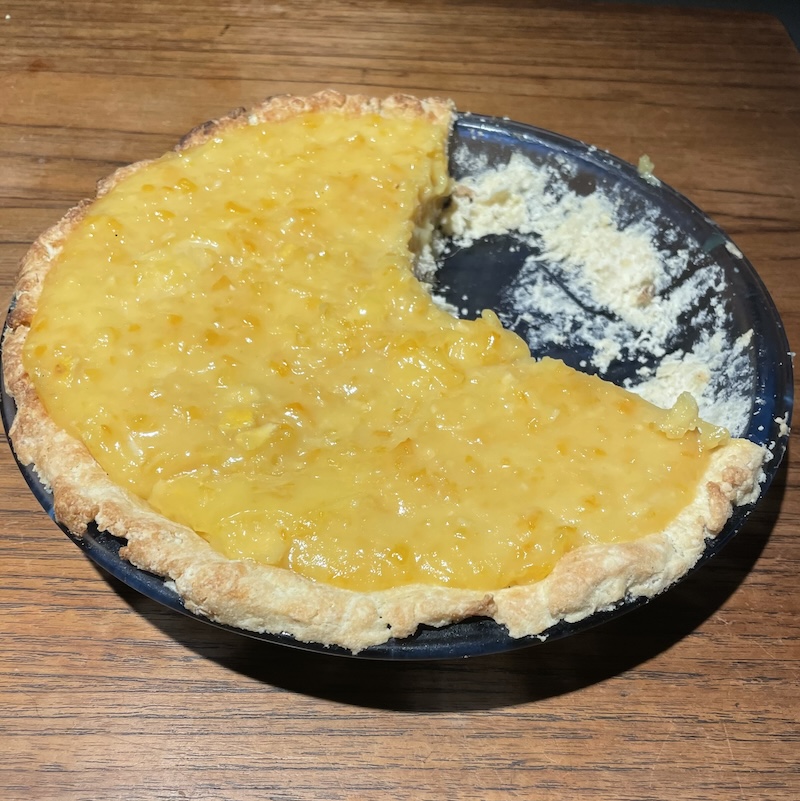
This vibrant pie is especially tart, due in part to the high amount of lemon juice, but also due to it having no meringue. Use fresh squeezed lemon juice for the brightest flavour. You can make and chill the pie up to 1 day ahead. Store leftovers in the refrigerator, covered with plastic wrap.
Yields:
8-10 servings
Time Required:
about 1 ½ hrs., plus several hrs.' chilling
Ingredients:
- 1 ¾ cups1 (420 mL) lemon juice (8-10 lemons)
- 2 lemons' zest2
- 1 ¾ cups (360 g) sugar
- ⅓ cup (45 g) corn starch (US/Canada), aka cornflour (UK/other)3
- ½ tsp. (3 g) salt
- 2 large4 eggs
- 6 large4 egg yolks
- 6 Tbsp. (85 g) cold, unsalted butter, sliced
- one pie crust (example recipe below)
Preparation:
In a medium pot, whisk lemon juice, lemon zest, and ½ cup (120 mL) water to combine. In a medium bowl, whisk sugar, corn starch aka cornflour, and salt, to combine. Whisk this mixture into pot, and then place it over medium-high heat, stirring occasionally, to reach simmer. Reduce heat to medium, and cook at a simmer, stirring occasionally, for 2 mins.
In a medium, heatproof bowl, lightly whisk whole eggs and egg yolks. When lemon mixture has come to a simmer, gradually add about ¼ of hot liquid to egg yolks, in a slow, steady stream, while whisking constantly to combine.
Whisk egg yolk mixture back into pot, and switch to a heatproof spatula. Reduce heat to medium-low, and continue to cook, stirring constantly, until mixture thickens, about 5 to 7 mins. It should come to a boil — not small bubbles around outer edge, but fat bubbles from centre of pot. (You should also see a distinct line that quickly closes in on itself if you drag your spatula through the curd.) Remove pot from heat, and stir in butter, a bit at a time. Mix thoroughly, to combine.
Strain lemon curd through a fine-mesh sieve5 into cooled pie crust, and spread into an even layer. Place plastic wrap directly over surface when pie is still hot, and chill until curd is set, at least 3-4 hrs., and up to overnight. Keep pie chilled until ready to serve.
Gluten-Free Pie Crust:
This crust has a flaky texture that can be difficult to achieve without wheat. Be sure to bake it thoroughly: Cooking to a golden-brown colour gives it a wonderful toasty flavour. This recipe is for one 9" (23 cm) crust.
Time Required:
- prep: 20 mins.
- bake: 17-20 mins5
- total: 37-40 mins.
Ingredients:
- 1 ¼ cups (195 g) gluten-free flour
- 1 Tbsp. (12 g) sugar
- ½ tsp. (1.5 g) xanthan gum7
- ½ tsp. (3 g) salt
- 6 Tbsp. (85 g) butter, cold
- 1 large3 egg
- 2 tsp. (10 mL) lemon juice or vinegar
- (optional) 2 tsp. (7 g) Instant ClearJel8
Preparation:
Preheat oven to 425°F (220°C). Lightly grease 9" (23 cm) pie pan.
Whisk together flour or flour blend, sugar, xanthan gum, salt, and (optional) Instant ClearJel.
Cut cold butter into pats, then work pats into flour mixture until crumbly, with some larger, pea-sized chunks of butter remaining.
Whisk egg and vinegar or lemon juice together until very foamy. Mix into dry ingredients. Stir until mixture holds together, adding 1-3 additional Tbsp. (15-45 mL) cold water, if necessary.
Shape into a ball and chill for 1 hr., or up to overnight. Allow dough to rest at room temperature for 10 to 15 mins., before rolling. Roll out on a piece of plastic wrap, on a silicone rolling mat, or in a pie bag that's been heavily sprinkled with gluten-free flour. Invert gluten-free pie crust into prepared pie pan.
Fill and bake5 as your pie recipe directs; note the yolk makes this crust brown quickly in the oven. Shield crust edges with aluminum foil, or a pie shield, to protect them from burning while baking. Store unbaked gluten-free pie dough, well-wrapped, in refrigerator for 2 days or in freezer for up to 2 months.
Cook's Notes:
Equipment needed: large mixing bowl, whisk, spatula, and pie pan. Saucepan for cooking the filling.
I've elected to use (and include above) King Arthur Baking's gluten-free crust recipe, but obviously any other will do, Including the pie recipe author's own, from https://cooking.nytimes.com/recipes/1019713-perfect-pie-crust.
For the filling recipe, I've simplified Erin Jeanne McDowell's recipe at NYT Cooking, finding it bit fussy (e.g., "fine sea salt") and overcomplicated, but her version may be worth trying. She "paints" the crust with an egg wash (omitted here), and tops the pie with shaped dough pieces as an artistic touch (ditto). She also suggests some may want to top the pie with lightly sweetened whipped cream.
1 Quarts, pints, cups, tablespoons, teaspoons, and fl. oz. are as defined in US Customary Units, not to be confused with differing British imperial, "legal", "coffee", Commonwealth of Nations, Canadian, Latin American, Japanese, Russian, or Dutch definitions — further proof that everyone needs the metric system.
2 I chose to use the rind from all eight lemons, in part because I chose this recipe specifically to avoid lemon-pie recipes uncommitted to the notion of lemon flavour — and indeed it came up with a pleasing amount of lemon zing. Rather than spend time finely dicing lemon rind, I just ran all the collected pieces through my food processor, to finely dice them.
3 "Corn starch" is powdered starch processed from the New World grain maize (from Spanish, orig. from Nahuatl), which grain the USA/Canada call "corn", unlike the rest of the English-speaking world, which reserves "corn" to mean cereal grains generically. This starch product, needed here in its customary role as a thickening agent, is called "corn starch" in the US/Canada, but "cornflour" in the UK and most other anglophone lands — not to be confused with whole maize grain: That product — not a thickening agent — is called "polenta", "corn meal", or "corn flour" in the US/Canada, depending on how finely milled, and called "maize flour" in the UK and most other places. Australians should beware that their "cornflour" is starch extracted from wheat kernel, sometimes more-helpfully labelled as "wheaten cornflour". As if that weren't confusing enough, the maize-based thickener may be labelled (in Australia) either as "corn flour" or as "corn starch", so beware. Further, the maize flour product, there, is labelled as "cornmeal".
Note that whole-maize grain is traditionally, in Meso-American cultures of origin, wisely soaked in alkaline solution ("nixtamalised") to increase bioavailability and thereby prevent niacin deficiency (pellagra), among other important benefits, yielding "masa" (lit. dough) aka "masa de maíz" (lit. maize dough), also available in dried & ground form as "masa harina" (lit. dough flour) aka "harina de maíz" (lit. maize flour), and in its unground form, hominy. As further complication, Americans distinguish "corn flour", meaning prepared from maize endosperm only, from "maize flour" for use of whole maize — the former, neutral-flavoured; the latter, much more nutritious.
Origin of the naming mess: Originally, North America shared with Mother England the language's original meaning of "corn" to mean cereal grains generically (from Old English "corn" meaning single seed of any cereal plant, orig. from Proto-Germanic "kurnam" meaning small seed). The colonists got the gift of maize from native peoples, therefore at first calling it "Indian corn". Later, in the USA and Canada, "Indian corn" got worn down to just "corn", while the original meaning of "corn" was lost, locally. "Maize" is thus now the least-ambiguous term in international contexts, though many Americans either don't know that word or reserve it for variants from Latin-American (and Spanish) cooking.
4 This insistence on "large" eggs in recipes is usually silly, and is here, too. If you have medium eggs, fine.
5 Straining the lemon filling is said to improve its texture, by removing significant rind pieces. However, leaving them in also turns out fine, so I do that.
6 Cited baking time for the original recipe with filling was "35 mins. (maybe a little more)", which I've reduced for parbaking it empty.
7 Xanthan gum is a thickener that's particularly handy in gluten-free cooking, where a small amount both thickens and add structure, much as wheat does. It's created by fermenting glucose using Xanthomonas campestris bacteria. In sauces and other liquids, one uses a ratio of xanthan to liquid of only about 0.1% to 0.3%.
8 Instant ClearJel is another thickener, produced by King Arthur Baking, and made from modified food starch, that activates upon contact with liquid.
Collected and re-published at http://linuxmafia.com/~rick/recipes/tart-lemon-pie.html by Rick Moen <rick@linuxmafia.com> on Mar. 12, 2025. Individual recipes are free from copyright. Share and enjoy!
Special thanks to Erin Jeanne McDowell for her generosity and talent. Ms. McDowell's original recipe appeared at https://cooking.nytimes.com/recipes/1019716-tart-lemon-pie. (That page's copyright notice is toothless as to the recipe itself, having force concerning only non-recipe elements such as photos.)
King Arthur Baking's Gluten-Free Pie Crust Recipe is taken from https://www.kingarthurbaking.com/recipes/gluten-free-pie-crust-recipe. King Arthur Baking is a superb and generous source for recipes and practical information on all aspects of baking, and I'm mirroring its recipe not because I fear it might vanish (though of course it could), but rather to further promote a cherished and endlessly useful recipe.
(If I have any copyright title in my own very minor contributions to this page — not my intention — they were created in 2025 by Rick Moen <rick@linuxmafia.com> and licensed for use under CC0. The image file (photograph) was taken on Mar. 12, 2025, also by Rick Moen <rick@linuxmafia.com> and licensed for use under CC0. I have thereby waived all copyright, compilation copyright, and related or neighbouring rights to this work. This work is published from: United States of America.)
