Sichuan1 Steamed Beef with Anise Rice
Recipe from Lawrence C. C. Chu
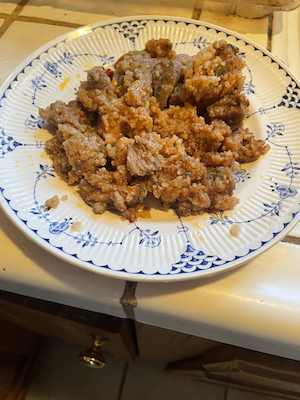
Here's a typical Sichuan dish served all over China. Since beef's bountiful and preferred in this country, I've suggested beef as the main ingredient. However, pork or chicken is equally flavourful.
Yields:
6-8 servings
Time Required:
- 120 mins. soaking rice, while doing other prep. work
- 10 mins. letting combined ingredients stand
- 30 mins. cooking time (or longer, as needed)
- 160 min. total time
Ingredients:
Spicy Rice:
- 1 lb. (0.45 kg) flank steak (or stew beef), cut into 1 ½" (4 cm) cubes
Marinade:
- 1 green onion, chopped
- 1 Tbsp. (15 mL) chilli paste
- 1 Tbsp. (15 mL) soy sauce
- 1 Tbsp. (15 mL) dry sherry
- 1 Tbsp. (15 mL) vegetable oil
Preparation:
Place rice in a bowl with enough water to cover; soak for 2 hrs. Drain well, and then crush (or process in food processor) with star anise. In a dry wok, toast until brown and fragrant.
Put meat in a bowl suitable for steaming. Stir in marinade ingredients and rice, and mix thoroughly; let stand for 10 mins.
To steam: Place bowl on rack in steamer, cover, and steam over boiling water for 30 mins. Remove, and place on top of serving platter, for easier handling.
Author's Notes:
If you substitute pork for beef, you'll need to steam it slightly longer, to cook it completely. (RM note: For food safety, use a cooking thermometer to ensure that unground beef or pork reaches 145°F = 63°C internal temperature, and then give it 3 mins. rest time. Poultry must reach 165°F = 74°C, Each meat choice has its own minimum safe internal temperature.)
Spicy rice mixture may be purchased in East Asian markets.
In China, this meat mixture is often wrapped in lotus leaves, and then steamed.
Serves two, if considered a single-dish meal.
Cook's Notes:
Equipment needed: 8" (20 cm) chef's knife, good cutting board, food processor, wok, cooking thermometer, steaming bowl and steamer, serving platter.
I improvised a steamer by putting a glass mixing bowl atop a vegetable steamer insert, inside a Le Creuset 5.5 qt. (5 L) enameled cast iron Dutch oven. The heavy lid kept in steam beautifully.
After experimentally cooking this dish once, mainly to test Lawrence Chu's unfamiliar technique of chopping up soaked, uncooked long-grain rice (with star anise), I judged the recipe's quantities too small, and tripled it for subsequent trials. Be aware that, if you do likewise, you'll need to be even more careful about safe internal temperatures for meats, i.e., check temp. in several places.
1 Chef Chu's spelling was "Szechwan", following the 19th Century Wade-Giles romanisation system predominant in 1980, when Chu's cookbook appeared, In today's now-preferred Hanyu Pinyin system, the name of that province on the upper Yangtze River is rendered "Sichuan".
2 Quarts, pints, cups, tablespoons, teaspoons, and fl. oz. are as defined in US Customary Units, not to be confused with differing British imperial, "legal", "coffee", Commonwealth of Nations, Canadian, Latin American, Japanese, Russian, or Dutch definitions — further proof that everyone needs the metric system.
3 Star anise is the star-shaped fruit of medium-sized evergreen tree Illicium verum, native to South China and north-east Vietnam, that resembles in flavour anise, seed of an unrelated plant, Pimpinella anisum, native to the eastern Mediterranean region and South-West Asia. Star anise is used in a variety of cuisines, and in the famous "five-spice powder" of southern China.
Your cooking will be improved by acquiring a spice grinder, and thereafter buying/storing only whole spices, grinding only as/when needed. Ground spices go flavourless quickly, even in tightly sealed jars.
For this recipe, I ground star anise, just before combining it with soaked rice in my food processor.
Taken from: Lawrence C.C. Chu's classic cookbook Chef Chu's Distinctive Cuisine Of China, p. 138. published 1980 by Harper and Row, which can be checked out in scanned format at Internet Archive. Thank you! (Chu's the chef / restaurateur of beloved local restaurant Chef Chu's, in Los Altos, California.)
Collected and re-published at http://linuxmafia.com/~rick/recipes/sichuan-steamed-beef-with-anise-rice.html by Rick Moen <rick@linuxmafia.com> on Sep. 17, 2026. Individual recipes are free from copyright. Share and enjoy!
(If I have any copyright title in my own very minor contributions to this page — not my intention — they were created in 2026 by Rick Moen <rick@linuxmafia.com> and licensed for use under CC0. I have thereby waived all copyright, compilation copyright, and related or neighbouring rights to this work. This work is published from: United States of America.)