Chef Chu's Famous Chicken Salad
Recipe from Lawrence C. C. Chu
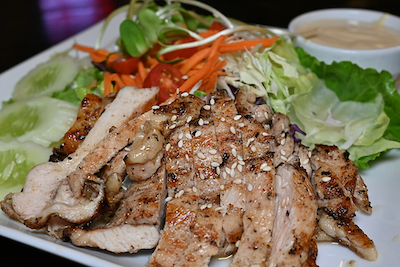
This dish is quick, healthy, simple, and delicious. To maintain its light fluffy quality, we toss the ingredients at the last minute, so it's nice and crisp. Our light mustard and sesame oil dressing, along with a dash of Five-Spice Salt, give it a bit of a bite.
Yields:
12 servings
Time Required:
- 25 to 30 mins. cooking time
Ingredients:
- 1 lb. (450 g) chicken, cooked (after shredding, about 2 cups1 = 475 mL)
- 2 cups (475 mL) vegetable oil
- 2 oz. (55 g) rice sticks2, pulled apart into smaller pieces
Hot Mustard Paste
- 2 tsp. (6.4 g) Colman's-style 3 hot mustard powder — but not Colman's brand
- 2 tsp. (10 mL) water
- 1 Tbsp. (15 mL) sesame oil4
- Half-head iceberg lettuce, shredded ¼" (5 mm)
- ½ cup (60 g) julienned5 carrots
- 10 or 12 sprigs Chinese parsley (cilantro)6 with stems, coarsely chopped
- ½ tsp. (1.2 g) Five-Spice Salt (below)
- ¼ cup (33 g) peanuts, crushed roasted
- 1 Tbsp. (8 g) sesame seeds7, toasted
- 4 Chinese parsley (cilantro)6 sprigs
Preparation:
Hand-shred the chicken meat, by pulling it apart in strands along the grain, or julienne5 it with a knife. Set aside.
To deep-fry: Heat vegetable oil in a wok to 375°F (190°C). Add rice sticks in small batches; deep-fry each batch a few secs., until puffy but still white. (Don't brown.) Remove, and drain on paper towels.
To make Hot Mustard Paste: Stir mustard and water together in a small bowl, to make a paste. Stir in sesame oil, until paste becomes smooth and shiny.
To assemble: The secret to the success of this salad is how it's assembled: Place lettuce, carrot, and chopped Chinese parsley in a large salad bowl. Sprinkle Five-Spice Salt evenly over lettuce mixture. Toss well, to distribute salt evenly. Rub Hot Mustard Paste around lower sides of bowl. Add chicken, peanuts, and sesame seeds evenly over lettuce. Toss well, to distribute Hot Mustard Paste evenly throughout salad. Adjust taste. Add three-quarters of the rice sticks last; toss lightly to distribute evenly. Reserve remaining rice sticks for garnish.
To serve: Mound salad on individual salad plates. Sprinkle remaining rice sticks over the top. Sprinkle with peanuts and sesame seeds. Garnish with a sprig of Chinese parsley.
Chinese Five-Spice Salt (hua jiao yan; 花椒盐)
- 2 Tbsp. (36 g) salt
- ¼ tsp. (0.5 g) Chinese five-spice powder8
Combine salt and five-spice powder in a small skillet. Place over moderate heat, shaking pan to agitate ingredients for about 1 min. Transfer to a condiment dish.
Store in a tightly sealed jar for 1 to 2 years.
Chef Chu's Garlic Dipping Sauce
- 3 Tbsp. (45 mL) ketchup9
- 1 Tbsp. (15 mL) soy sauce10
- 1 tsp. (4 g) sugar
- ½ tsp. (1 g) fresh ginger11, minced
- ½ small clove garlic, minced
Combine all ingredients well, in a small bowl.
Author's Notes:
You may use leftover cooked chicken (fried, barbecued, rotisseried, steamed, smoked, or stir-fried) or duck for a different flavour. Slightly warm the chicken or duck, or serve at room temperature for richer flavour.
Add the crisp poultry skin, julienned5, to add texture and flavour to the salad.
Five-Spice Salt is added to the lettuce first, to distribute it evenly. If added when Hot Mustard Paste is tossed in, it can stick to the mustard and have an unpleasant taste. Also, if added too early, it can wilt the lettuce.
Some customers enjoy sprinkling a little of Chef Chu's Garlic Dipping Sauce (above) over each individual serving, for a different flavour sensation.
Cook's Notes:
Equipment needed: Chef's knife, wok, cooking thermometer, paper towels, two small bowls, stirring implements (for wok phase and for later mixing), large serving (salad) bowl, small skillet, condiment dish, small sealable jar.
This style of "Chinese chicken salad" was invented by Sylvia Cheng Wu (to please Cary Grant) in 1959 at Wu's Garden Restaurant in Santa Monica, California — not in China.
1 Quarts, pints, cups, tablespoons, teaspoons, and fl. oz. are as defined in US Customary Units, not to be confused with differing British imperial, "legal", "coffee", Commonwealth of Nations, Canadian, Latin American, Japanese, Russian, or Dutch definitions — further proof that everyone needs the metric system.
2 Rice sticks, also called rice vermicelli or rice noodles, are thin, long, brittle sticks made from rice flour and sold in 4-to-6 oz. (110-to-170 g) packages. When deep-fried, they puff up and become lightly crunchy. Or, soaked in water, to become soft and noodle-like, they're used in soup or chow mein. Store dry rice sticks, tightly wrapped, in a dry location almost indefinitely.
3 Mr. Chu's 1980 recipe did call for Colman's product. That was then; times change.
In a sad if familiar story, after 165 years of iconic, top-quality English mustard products, in 1995 (after Chu's cookbook went to press), this iconic Norwich-based company was bought out by Unilever and ruined within five years. So, avoid Colman's (brand). Fortunately, "Colman's-style" alternatives exist (such as from Penzey's): Search for "hot mustard powder" or "Colman's-style hot mustard powder" — or DIY.
The fate of Reckitt & Colman, Ltd. illustrates why you should never just trust branding: Brands are products subject to ruination by apathetic corporate buyers, who assume you'll just keep buying a famous name, while & after they turn the product into generic pap.
The original powder mix was part yellow (aka white) mustard seeds (Sinapis alba), part brown mustard seeds (Brassica juncea), ground and mixed, usable to amplify flavour and especially umami in a variety of dishes. It also served as an emulsifier. The difference between the two seeds' taste effect is complicated, and depends on treatment.
4 Sesame oil's aromatic, flavourful, and extracted from roasted white sesame seed. Use lightly to season foods, a wonderful flavour enhancer. Store, tightly sealed, in refrigerator for up to 2 weeks.
5 Julienning is a culinary knife technique, in which the food item is cut into long thin strips, similar to matchsticks. Usual method's to trim the ends, then trim edges to make four straight sides, to make the subsequent uniform cut easier.
This cut's commonly used for carrots, celery, potatoes, and cucumbers.
6 Chinese parsley, also called cilantro or coriander, is a flat, leafy vegetable that resembles parsley but isn't parsley. It has a distinctive, fragrant taste, and is excellent as a garnish. Store in the refrigerator for 3 to 4 days.
RM note: Many anglophone countries including the UK call these "coriander leaves". Americans call only the plant's seeds "coriander", calling its leaves "cilantro", the Spanish word for coriander.
7 Sesame seeds are flat with nutty flavour, and available in black and white varieties. Toasting improves the flavour. They're used most often in pastries or as a garnish, or as a last-minute addition to dishes such as this chicken salad. Store in a tightly sealed jar for up to 1 year.
8 Five-spice powder, also called Chinese five-spice, is a strongly flavoured combination of ground anise, cinnamon, fennel, cloves, and Sichuan peppercorns.
Sichuan peppercorns, hua jiao; 花椒, also called wild peppercorns, have a subtle, delicate smell and mildly hot taste. They're spicier than black peppercorns. It's the fruit husk of aromatic trees native to Sichuan Province on the upper Yangtze River, harvested from any of several species in genus Zanthoxylum (the "prickly ashes"), related to citrus and unrelated to anything else called "pepper".
RM note: Chu's spelling was "Szechwan" for the famous pepper, following the 19th Century Wade-Giles romanisation system predominant in 1980, when Chu's cookbook appeared, In today's now-preferred Hanyu Pinyin system, that name's rendered "Sichuan".
9 Chu wrote "catsup", still in 1980 the predominant US spelling, thereafter (mostly) altered by corporate marketing to "ketchup" .
10 Soy sauce is the fundamental seasoning in Chinese cooking. Made from fermented soy beans, flour, salt, and water, it comes in various ways: Extra Dark's used for stewing or "red cooking" (hóng shāo; 红烧), a Chinese term referring to a slow-cooking process similar to stewing. Meat's browned first, and then cooked in plenty of liquid — usually dark soy sauce and other seasonings — until tender. Cooking time ranges from 1 to 4 hrs., and the result is a succulent piece of meat with a robust, reddish-brown colour.
Black or Dark soy sauce, slightly sweeter, is used for general stir-frying, marinating, and dipping. Light or Thin doesn't have caramel colouring, and so is used in dipping or marinating light-coloured foods, such as seafood and vegetables. In our recipes, when we call for soy sauce, we mean Black or Dark, except where otherwise noted. Store at room temperature for up to 6 months.11 Ginger's an aromatic, pungently spiced, gnarled root. The skin, resembling a potato's, is fairly thin, and ginger should be peeled before using; the root is knobby. Ginger's usually crushed or minced, or occasionally sliced, such as when seasoning a wok. Dry ginger and ground ginger powder are not satisfactory substitutes. Store fresh ginger in the refrigerator for 1 to 2 weeks.
Taken from: Lawrence C.C. Chu's classic cookbook Chef Chu's Distinctive Cuisine Of China, published 1980 by Harper and Row, which can be checked out in scanned format at Internet Archive. Thank you! (Chu's the chef / restaurateur of beloved local restaurant Chef Chu's, in Los Altos, California.)
That 1980 first edition didn't yet have this exact recipe, but I found it excerpted from a later edition, here.
All footnotes other than #1, 3, 5, & 9 were taken (very lightly edited & updated) from elsewhere in Chu's cookbook, and are his wisdom, not mine.
Collected and re-published at http://linuxmafia.com/~rick/recipes/chinese-chicken-salad.html by Rick Moen <rick@linuxmafia.com> on Aug. 20, 2026. Individual recipes are free from copyright. Share and enjoy!
(If I have any copyright title in my own very minor contributions to this page — not my intention — they were created in 2026 by Rick Moen <rick@linuxmafia.com> and licensed for use under CC0. I have thereby waived all copyright, compilation copyright, and related or neighbouring rights to this work. This work is published from: United States of America.)
Image (used, here, unmodified) is Copyright © 2026,by PattayaPatrol, who licensed it for use under CC-BY-SA-4.0 International. This is a placeholder image, until I can make this recipe and provide a better-matching photo licensed under CC0 terms.
