Chicken Paprikash (Paprikás Csirke)
Recipe from Kimberly Killebrew
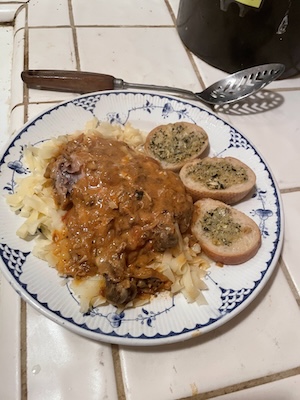
Chicken Paprikash is the most famous and popular Hungarian main dish, made from simmering chicken in a rich, creamy sauce with an abundance of Hungary's signature spice, paprika, a key ingredient. It is often served with dumpling-like boiled egg noodles (nokedli), a broad noodle similar to the German spätzle1, or with tagliatelle, rice, or millet.
In Hungarian, this dish, invented in 1830 by István Czifray, court chef of Archduke Joseph, would be called Paprikás (paprika) Csirke (chicken).
Yields:
12 servings
Time Required:
- prep: 10 mins.
- cooking: 50 mins.
- total: 60 mins.
Ingredients:
- 4 Tbsp.2 (51 g) pork lard (preferred) or butter3
- 6 lb. (2.8 kg) chicken pieces, bone-in and skin-on preferred
- 4 med. yellow onions, very finely chopped
- 4 cloves garlic, finely minced
- 4 Roma tomatoes, seeds removed, very finely chopped
- 2 Hungarian bell peppers4, diced (opt.)
- 6-8 Tbsp. (40.8-54.4 g) top-quality5 sweet Hungarian paprika
- 4 cups (945 mL) quality chicken broth6
- 3 Tbsp. (48 g) sea salt7
- 1 tsp. (2.4 g) freshly ground8 black pepper
- 6 Tbsp. (46.9 g) flour
- 1.5 cup (355 mL) full-fat sour cream9 (at room temp. to avert lumping)
- ½ cup (120 mL) heavy whipping cream9
Preparation:
Heat lard (or butter) in a large Dutch oven or heavy pot, and brown chicken on all sides. Transfer chicken to a plate.
In the same oil, add onions, and fry until golden brown. Add garlic and tomatoes (and bell pepper, if using), and fry another 2-3 mins. Remove pot from heat before next step (because paprika becomes bitter if scorched).
Stir in paprika, salt, and pepper. Return chicken to pot, and place pot back over heat. Pour in chicken broth. Chicken should be mostly covered.
Bring pot to a boil. Cover, reduce heat to medium-low, and simmer 40 mins. Remove chicken, and transfer to a plate.
In a small bowl, stir flour into sour cream/cream mixture, to form a smooth paste. Stir cream mixture into sauce, whisking constantly to prevent lumps. Bring pot to simmer for a couple of mins., until sauce is thickened. Add salt and pepper to taste. Return chicken to sauce, and simmer to heat through.
Serve Chicken Paprikash with Hungarian nokedli, which is a pasta resembling German Spätzle, only very short and stubby. You can make nokedli with a spätzle scraper, using recipe cited below for the dough.
Cook's Notes:
This is about the best chicken dish (overall) that I think I've ever cooked. Some care is justified with selecting the signature spice, as I'll detail in footnotes.
Equipment required: Large Dutch oven, small bowl,
spätzle
scraper
(if making nokedli), spice grinder.
Home-made pasta
Recipe from Kimberly Killebrew
Depending on what tool you use to shape the pasta from the pasta dough, this would make Ms. Killbrew's native Swabian Spätzle, Hungarian nokedli, or something else.
Yields:
6 servings
Time Required:
- prep: 25 mins.
- cooking: 10 mins.
- total: 35 mins.
Ingredients:
- 2 cups (240 g) flour
- 1 ½ tsp. (9 g) salt
- ⅛ tsp. (0.3 g) freshly ground nutmeg (opt.)
- 4 large eggs11
- ½ cup (120 mL) milk or water (milk makes the dough richer)
- butter for serving
Preparation:
Spätzle batter can be mixed by hand, or by using a stand mixer, which is much easier. Add flour, salt, and nutmeg (if using) to the bowl of a stand mixer. Stir to combine. Crack eggs into a small bowl, and whisk them. Make a well in the center of flour mixture, and pour eggs into it. Add milk (start with using slightly less, and add more as needed). Attach a paddle attachment to the stand mixer, and "knead" the dough for about 10 mins. or until bubbles appear. After 10 mins. or so of beating, use a wooden spoon to scoop and pull the dough. If bubbles/holes appear, the dough is done.
Bring at least 2 quarts/litres of lightly salted water to a boil, then reduce to a simmer. Using a Spätzle maker of your choice (I use, and prefer, the Spätzle press), press the noodles into simmering water, and cook for about 2-3 mins, or until noodles float to the top. Use a slotted spoon to transfer noodles to a colander, to drain the hot water, and then to large bowl of ice water. (This firms them up for a better/chewier texture.) After a min. or two, transfer them to a colander to drain completely. Before serving, warm them through in a skillet, with some melted butter.
Make Ahead: Spätzle can be stored in the fridge for at least a couple of days, and then reheated. Melt some butter in a large skillet, and toss Spätzle in, to heat through. Alternatively, they can be microwaved in a covered dish.
Author's Notes:
Add more flour if dough's too runny; add more milk or water if it's too stiff.
Traditionally, Spätzle batter is quite thick, because it was cut into noodles using the board & knife method. Even if using a Spätzle press or other method, thicker batter yields a better consistency. If you’re using the Spätzle press, yes, it will require some muscle strength: You don’t want the batter to be so runny that it squishes right through with ease. That said, if you’re straining way too hard to press the batter through, go ahead and add a bit more liquid to thin it out.
Optional inclusion of freshly ground nutmeg isn't traditional, but adds a nice flavor.
Equipment needed: Stand or other mixer, small bowl, wooden spoon, your choice of a tool to shape the pasta from dough, large pot to boil pasta, slotted spoon, colander, large bowl with ice water to receive cooked pasta, and a skillet.
1 "Spätzle" (or Spatzen or Spätzla) is the German name for a type of Central European egg pasta with an irregular form and rough, porous surface, typically served as a side for meat dishes with sauce. The Hungarian name would be "nokedli". They're quite a bit like the Italian gnocci.
2 Quarts, pints, cups, tablespoons, teaspoons, and fl. oz. are as defined in in US Customary Units, not to be confused with differing British imperial, "legal", "coffee", Commonwealth of Nations, Canadian, Latin American, Japanese, Russian, or Dutch definitions — further proof that everyone needs the metric system.
3 Kosher alternative: schmaltz or a good margarine.
4 Intended reference is to the Hungarian wax pepper, a variety of Capsicum annuum chilli pepper bred in Hungary and first documented by a German botanist in 1790. However, certainly any medium-sized bell pepper with a pleasing yellow or red colour will do fine.
5 You might ask, does paprika being Hungarian make a difference? Well, maybe. They aim for specific flavour profiles using Capsicum annuum cultivars grown distinctively in Hungary, concentrating on a complex, robust flavour profile. Commercial paprika here in California is crafted mostly for its colour. On the other hand, quality culinary paprika's possible anywhere. As someone who grows his own hot peppers and deyhdrates them for uses including powders, I think it's possible to do well on a DIY basis — but getting Hungarian paprika is cheap insurance when flavour matters.
Locally, I cannot find imported Hungarian paprika, even at premium markets, but Penzey's Spices has two different Hungarian-style paprikas, and I trust them to get it right.
Imports can be bought online — of course raising concerns about freshness.
6 The author, who's in Germany, most strongly recommends Aneto brand, which I'd guess is available only in Europe, for store-bought chicken broth. NY Times did a 2025 comparison test, yielding some useful options for those seeking a cut above, including some bone broths.
7 If all you have is table salt, good enough, except use 2 Tbsp. (or just weigh out the same 48 g), to account for finer crystals.
8 Your cooking will be improved by acquiring a spice grinder, and thereafter buying/storing only whole spices, grinding only as/when needed. Ground spices go flavourless quickly, even in tightly sealed jars.
9 Kosher alternative: Tofutti non-dairy sour cream (palm oil-based).
10 Kosher alternative: Open Nature dairy-free heavy whipping cream alternative (coconut-based).
10 This insistence on "large" eggs in recipes is usually silly, and is here, too. If you have medium eggs, fine.
Collected and re-published at http://linuxmafia.com/~rick/recipes/chicken-paprikash.html by Rick Moen <rick@linuxmafia.com> on Apr. 30, 2026. Individual recipes are free from copyright. Share and enjoy!
Taken from: https://www.daringgourmet.com/chicken-paprikash-paprikas-csirke/ for the main dish, and https://www.daringgourmet.com/homemade-german-spaetzle/ for the pasta, both by talented chef Kimberly Killebrew. Thank you!
Also worthy of note is a similar recipe by Sam Sifton at https://cooking.nytimes.com/recipes/1018068-chicken-paprikash.
(If I have any copyright title in my own very minor contributions to this page — not my intention — they were created in 2026 by Rick Moen <rick@linuxmafia.com> and licensed for use under CC0. The image file (photograph) was taken on Apr. 30, 2026, also by Rick Moen <rick@linuxmafia.com> and licensed for use under CC0. I have thereby waived all copyright, compilation copyright, and related or neighbouring rights to this work. This work is published from: United States of America.)