Chewy Tollhouse Cookies
Recipe from Alton Brown
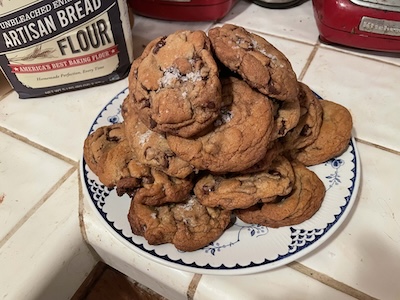
This is an absolutely fabulous, amended variant of the historic "Toll House" cookie recipe, originally invented by Whitman, MA chef and hotelier Ruth Graves Wakefield in the 1930s, at her and her husband's Toll House Inn, known to many generations of buyers of Nestlé's semi-sweet chocolates, courtesy of a marketing deal: Nestlé got to print Wakefield's immensely popular 1938 "Toll House Chocolate Crunch Cookies" recipe on their semi-sweet chocolate bar (and later, morsel) packaging. In return, Wakefield got a lifetime supply of chocolate.
However, as the Mad Scientist of Cooking, Alton Brown, has shown, Wakefield's recipe has long been ripe for improvement: In the Dec. 13, 2000 episode "Three Chips for Sister Marsha" of his Food Network TV series Good Eats, Brown debuted his first improved version, which he called The Chewy Chocolate Chip Cookie. Then, 26 years later, he improved it a second time, yielding his "Chewy 2.0" recipe, reproduced here.
Yields:
2 dozen cookies
Time Required:
- 20 mins. prep. time (not counting overnight refrigeration)
- 30 mins. cooking time
- 50 mins. total time
Ingredients:
- 227 g1 butter2 (2 regular sticks)
- 225 g light brown sugar3
- 60 g white granulated sugar
- 310 g bread flour4
- 5 g baking soda
- 6 g kosher5 salt
- 3 g dried milk powder6
- 1 egg + 1 egg yolk
- 45 mL water
- 7 g vanilla extract
- 340 g (12 oz.) semi-sweet chocolate chips7
- Maldon finishing salt (opt.)8
Preparation:
Cut the butter into small pats, then melt it in a saucepan at low temperature for about 7-10 mins., boiling out the water content and leaving the milk solids at the bottom to brown along with the clarified butterfat. When all butter is melted, turn heat to medium and listen for gurgling of the water under the butterfat, You want that gurgling (showing the water is boiling out), but not popping of butter. You'll know the water's been mostly boiled out (and that, now, caution must be applied to prevent burning the milk solids at the bottom, which makes butter inedible), when the bubbling starts to stack up as foam, and hang around longer.
Lower heat a bit, stirring to brown the butter. Butter should achieve 275-280°F (135-138°C), in the saucepan, but the moment you start to smell a nutty odour, you're done and should not wait to use a thermometer (due to risk of burning). You can confirm doneness by moving aside some of the foam and seeing slight browning of the cooked milk solids. It would be ideal to have a Pyrex or other heat-proof container standing nearby, to receive the browned butter, to prevent burning.
About 3% of butter is milk solids, which furnish lactose, which, as a "reducing sugar", when heated with certain proteins such as milk protein (casein), creates the much-prized Maillard reaction, producing a burst of flavour by frying the milk solids. That is the point of browning the butter in this recipe's first step. Set aside the browned butter to cool.
In stand mixer on low, place sugars in the bowl first, and add melted butter. Mix at low speed with a paddle, just until sugar and butter come together.
In separate bowl, mix or sift together flour, baking soda, salt, and milk powder.
In another small bowl, mix egg, egg yolk, water, and vanilla extract.
Restart mixer on medium-low. Add eggs (w/ vanilla extract), slowly, to mix them into butter/sugar mix rather than just sitting on top, forming an emulsion of the water-based butter and the oil-based eggs.
Add in dry ingredients, slowly: A paper plate is good for this. With ⅓ of the dry ingredients at a time on the plate, slowly shaking it into the mixer bowl. At a low "stir" speed, add the chips into the batter9.
Use 22 mL (1 ½ Tbsp.) disher (or tablespoon) to scoop out batter, 60 g per cookie, onto parchment paper-covered baking plates or sheets or whatever. Refrigerate the dough for 10-12 hrs., covered with plastic wrap to protect it from other foods' odours. This "resting" allows it to hydrate, meaning that the flour and milk solids will fully absorb moisture, allowing for passive gluten formation, thus chewiness. It will also make the dough more plastic, resulting in more-even cooking, and ultimately adding more flex to the cookies.
Don't get impatient and skip overnight refrigeration. It's important to the dough's development.
Transfer cookies to a pair of parchment paper-covered half sheet pans10, six cookies each, with the dough still cold, and minimal delay in getting them into the oven, to limit cookie spread in the oven. Optionally, sprinkle each cookie with a few flicks of Maldon finishing salt.8
Bake at 375°F (190°C) for about 6-7 mins., swapping and rotating baking pans to even out baking, then continue baking another 7-8 mins (checking for overall doneness at around 12 mins. total elapsed cooking time). Cool on racks. You should now have a dozen finished cookies, so repeat with the remaining dozen cookies.
Cook's Notes:
Equipment needed: silicone spatula, 2 half sheet pans (each used twice), parchment paper, a 2 L (2 qt.) saucepan, a couple of paper plates, sifter, stand mixer with paddle attachment, large mixing bowl, small bowl, cooling rack, 22 mL (1 ½ Tbsp.) disher (or tablespoon).
A "disher" is a device like an ice cream scoop. If, like me, you don't have one, a tablespoon will do.
1 Ordinarily, I'd have a footnote pointing how inadequate either US Customary or Imperial volume units are because of conflicting and ambiguous definitions, and how we really all need the metric system, but Alton Brown's already done the metrication work for me. Also, in his video, he proves that measuring flour, in particular, by volume was always a bad idea, that only measuring it out by weight can give consistent and good results for a recipe like this one, where accuracy matters.
So, if you haven't already, get a cheap electronic kitchen scale, and start learning to love it. That really is a better way. Now, if only existing recipes from USA/UK/etc. sources were recalibrated to specify ingredients by weight. We can dream.
2 Recipe assumes US-typical butter, which has a higher water content (mostly 16-18%) than does European butter (around 10-14%), the latter thus tending to be richer and creamier. Some premium American butter brands, such as Strauss Family Creamery, weigh in around 12.59% water, very low indeed. Land O'Lakes, the pedestrian brand Alton Brown used, is among the most watery, at 17.78% water.
3 Light brown sugar usually has about 3.5% molasses by weight, while dark brown sugar has about 6.5%. So, dark's flavour is richer, aside from its darker appearance.
4 Bread flour has markedly higher protein content (as high as, for ideal bread flour, 14%+ protein) than all-purpose flour, hence a higher amount of gluten, giving these cookies their chewy structure.
5 As usual, the meaning is not salt prepared according to the rabbinical laws of kashrut (though that of course would be fine), but rather natural salt with large crystals, as koshered salt does. Its large, open structure furnishes a tactile difference from ultra-compact table salt, tastes less salty than an equal volume of table salt, and lacks the slight bitterness that most table salt picks up from the iodine and anti-caking agents added to it. In contrast to "sea salt", it's also purified rock salt from on-land salt mines, hence has a very consistent crystal size and flavour profile, while sea salt can be all over the map in its characteristics, and can be very appealing but also very individually distinctive by brand and origin.
6 Because dairy doesn't love me, and because I suspect powdered milk's very unhealthy for human beings (because of cholesterol oxidation), and refuse to have it in my house, I substitute 45 mL (about ¼ cup) of real whole milk (in my case, lactose-free), and omit powdered milk and water entirely. Alton Brown mentions that the milk is helpful in hydrating bread flour, which requires more liquid than all-purpose flour.
In fairness, I'll mention that Alton Brown introduced the powdered form of milk into the Chewy 2.0 recipe because, over the years, people had reported inconsistent results using the 1.0 recipe's call for liquid milk, and powdered milk + water was his remedy, 26 years later.
7 You can do so much better than Nestlé (or Hershey). Look for Ghirardelli, Guittard, Pascha, Gefen, or Callebaut.
8 Maldon salt (specifically, Maldon Sea Salt Flakes) is a widely available brand of flaky sea salt harvested in Maldon, County Essex, on the SE English coast. It has large, pyramid-shaped flakes, and is used to add crunchiness and flavour to cooked dishes. The term "finishing salt" is a functional category, meaning any salt added to give a finishing element of texture and flavour to a dish before serving. The general rule is that a little goes a long way: Use sparingly at first; taste before adding more.
9 Lick raw batter off the beater? Alton Brown claims the health risk isn't undercooked or raw eggs, at least not here in the USA, and that salmonella contamination (from chicken eggs) is essentially unheard-of. (That's a matter of judgement. I don't concur with that risk assessment.)
Rather, he said, the real danger is E. coli bacteria in the flour — but this risk (as to the flour) can be averted by heating all of one's flour in a bowl, in one's oven, at 300°F (150°C) for ten mins., to heat-sanitise it.
About eggs: I happened to have accumulated 36 egg cartons. All bore the prominent warning USDA requires for unpasteurised egg products. Never assume any such product is pasteurised without checking, and, even for pasteurised products, post-purchase pathogen growth may become a danger. In short, it remains prudent to never eat raw / undercooked eggs.)
10 I'd always lazily assumed "baking sheets" (aka "sheet pans") and "baking pans" meant the same thing, but it turns out there's a significant difference between baking sheets/sheet pans, on the one hand, and baking pans, on the other. Baking pans are significantly deeper, in other words have higher sides, which permit cooking juicy or runny foods without spillage. You might use them for lasagnas, casseroles, or cobblers, for example. Some are metal, ceramic, stoneware, reinforced silicone, or tempered glass (which heats quickly, and could burn food if one isn't careful), whereas baking sheets are almost always metal.
The difference in structure and amount of material can affect cooking time, so be careful in substituting one for the other.
The other difference is that baking pans lack a standardised size and shape, while a full-size (US) baking sheet is always 26" x 18", and half-size is 18" x 13", the size that fits in home ovens as opposed to restaurant.ones, and quarter-size is 13" x 9", often used for baking cakes and able to fit in toaster- and countertop ovens. (I have no knowledge of metric baking pan sizing, outside US/Canada.)
Taken from: https://www.youtube.com/watch?v=Wvv5cvWoxw0, as Alton Brown's recipe. Thank you!
Collected and re-published at http://linuxmafia.com/~rick/recipes/chewy-tollhouse-cookies.html by Rick Moen <rick@linuxmafia.com> on June 18, 2026. Individual recipes are free from copyright. Share and enjoy!
(If I have any copyright title in my own very minor contributions to this page — not my intention — they were created in 2026 by Rick Moen <rick@linuxmafia.com> and licensed for use under CC0. The image file (photograph) was taken on June 20, 2026, also by Rick Moen <rick@linuxmafia.com> and licensed for use under CC0. I have thereby waived all copyright, compilation copyright, and related or neighbouring rights to this work. This work is published from: United States of America.)