Fourth Amendment Case Studies
by Rick Moen
April 28, 2026
[This is my side of an instructional conversation on the Nextdoor social-media service about Fourth Amendment1 rights in police encounters, including examples from my own experiences. I decided to record it here, rather than let it vanish with other Nextdoor ephemera. (For this page, I've annotated that original discussion with clarifying footnotes, a table of contents, etc.)]
- Four police stories, moving backwards in time
- A fake officer pulling a con, Cupertino, 2026
- An exigent circumstance, West Menlo Park, 2021
- Officers pushing boundaries and pratfalling, Moraga, 2009
- Me being rolled by SFPD through naïveté, San Francisco, 1983
- "Warrant" is a slippery term; also, two types of judicial warrants
- Terry stop vs. arrest vs. consensual encounter: distinctions
- Terry stop vs. arrest vs. consensual encounter: which is it today?
- More about exigent circumstances
- Summary and lessons learned
Example 1: When Is an Officer Not Even an Officer? Cupertino, 2026
Your business gets a surprise visit from a police officer — or, at least, he looks a little like one, and claims to be one. He's masked, wearing a camo vest with "POLICE" across the back, has what might be a handgun on his belt, and says he's there to do an "inspection". You're the front desk employee. What's your response?
"Let the officer do his inspection" is the wrong move. Here's an
illustration of why — and why we all need to understand our rights
under the Fourth Amendment:
http://www.sfgate.com/news/bayarea/article/cupertino-authorities-arrest-police-impersonator-22223389.php
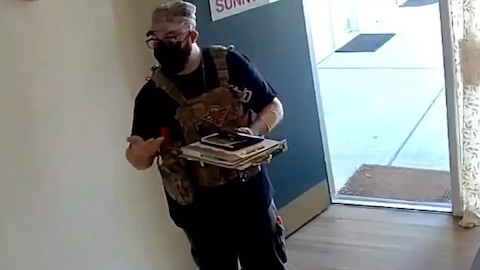
Brendan Kroning of San Andreas is a serial con artist, who's believed to pull this scam on multiple businesses, and, on April 15th, executed it at Sunny Spa, Cupertino. The employees moved aside for his "inspection", which consisted of unplugging the security cameras, demanding an employee open the cash register (one did), then grabbing a large amount of cash, running out, and driving away. (The "handgun" was probably a pellet gun.)
Sheriff Office deputies have tracked down Kroning, who is of course not a police officer, and arrested him.2 Meanwhile, if I were Sunny Spa's owner, I'd be disappointed employees' BS detectors hadn't rung multiple times:
- Entering masked was highly suspicious.
- Since anyone can buy a vest with "POLICE" written on it, the "officer" failing to show ID or a peace officer badge, nor stating his alleged police agency, was highly suspicious.
- Officers don't do "inspections".
- That demand to open the cash drawer for his "inspection" should have been an automatic "no".
But here's the kicker:
- Another word for "inspection" is "search", and, in this country, search requires a valid judicial (signed by a judge) search warrant, stating the correct address and date of the search.
The responding employee should have said "Officer, may I see your search warrant? Otherwise, wait here." And motioned for someone else to call 911, and then also call upper management (to keep them informed).
Even if one accepted the stranger's claim to be an officer — instead of a con artist — no officer has the lawful right to just enter and search. (There are narrow exceptions such as hot pursuit of a fugitive, an example of "exigent circumstance". In those cases, officers will not ask permission, just state they're coming in. You call 911; the department explains later.)
I've drilled members of my family in this: No pushy strangers get our consent to enter our home, just because they claim they're "police".
Here's the Fourth Amendment:
The right of the people to be secure in their persons, houses, papers, and effects, against unreasonable searches and seizures, shall not be violated, and no Warrants shall issue, but upon probable cause, supported by Oath or affirmation, and particularly describing the place to be searched, and the persons or things to be seized.
More, including exceptions such as "exigent circumstances": https://en.wikipedia.org/wiki/Fourth_Amendment_to_the_United_States_Constitution
Please note: I did not say the employees should have physically blocked a man they believed was (at least) armed with a firearm, merely that they (a) should not have cooperated in his heist, (b) should have disbelieved his claims, and (c) should have called 911 and fled to safety.
Kroning is believed to have gotten away with this scam on multiple occasions, because employees failed due diligence.
Example 2: An Exigent Circumstance: West Menlo Park, 2021
An example of an exigent circumstance (detailed below, as certain exceptions to the Fourth Amendment's requirement that officers have and present a search warrant) at my residence: A few years ago, late at night right around July 4th, I heard voices in my large side/back yard and called out a challenge from my back porch. A voice answered saying he was a San Mateo County Sheriff Office deputy, explaining he and another officer had pursued someone firing off illegal fireworks, who appeared to have fled into my yard. I believed him and accepted this, thanked him, and went back indoors.
That was hot pursuit, a Fourth Amendment exception, and also I was fine with SMCSO going after that person through my yard.
Example 3: Officers Pushing the Limits: Moraga, 2009
To further my earlier point: Never, ever physically oppose someone claiming to be a police officer — but that doesn't require getting conned, nor cooperating. Actual police officers are well intended public servants, but are trained to aggressively push their authority, and often don't know the limits. A story:
Around 2009, there was an awkward situation at my agèd Mom's house in Moraga: My sister Michele Moen Strickland and her husband Michael Strickland, both then about age 50, had moved in (2006) and were squatting, refusing to move out. (Mom, age 82 at the time they moved in, and in frail health, repeatedly demanded they vacate, so she could arrange her old-age provisions as she preferred, and they simply ignored her repeated demand as inconvenient. Sis justified this piratical act by claiming she was Mom's "caregiver", a role never granted her, one Mom specifically rejected.3.)
I drove there once or twice a month to make out bill payments for Mom's signature, file banking paperwork, and visit. Sis's hubby on numerous occasions tried to deter my visits, by threatening me (for no apparent reason, and with no inciting trigger I could ever identify4) with violence, which I ignored, as always, attempting to avoid conflict. This had just happened again (another "I'm going to beat you up" eruption), I'd (as before) ignored this, and returned to Mom's office (room) to prepare bill payments — when, suddenly, a Moraga PD officer entered.
"The residents are unhappy you're here." (Some of her colleagues were
talking to Sis.)
"By 'the residents', do you mean my sister and her husband? I'm sorry
the squatters are unhappy, but the actual homeowner, who's napping
upstairs, invited me."
"We don't want to bother an old lady."
"OK". (I returned to my work.)
"I'll need to see some ID."
I'm trained in the law, and knew she was already transgressing: California gives officers no power to require persons to even state their names, let alone present photo ID (unless under arrest or stopped while driving), but I thought I knew where this was going, so pulled out my US passport.
She grimaced, and said "Do you have a driver's license?" I do, but it was pretty clear she knew she had no authority to demand one, yet I figured it was nonetheless in my interest to indulge her overstepping. Why? Because she hoped looking up my "record" would yield leverage, permitting them to pressure me to leave Mom's house. I knew they'd find a scarily clean record, and see that they shouldn't mess with me, so fished out my driver's license. She went off to "run" it. I vowed to myself that the charade had ended.
A few minutes later:
"When are you leaving?"
"That's my business. I'm doing Mom's paperwork, then spending personal
time with her."
"How long is that going to take?"
"It'll take however long it takes. Again, I'm here at her invitation,
doing her work and visiting her. I'm not answerable to you."
"If you won't leave, we'll just have to take everyone down to the
station."
I visibly relaxed, smiled, and said in a soft voice "You could do that,
but then there will be one hell of a lawsuit."
[Oh oh.] "Wait here."
"I'm not going anywhere." (I returned to my work.)
Officer Friendly returned with her squad commander. "Please repeat what you told me." I did so, and returned to my work.
And every one of the officers silently left the house.
I'd made very clear that I would not physically oppose any illegal arrest, detaining, search, or seizure, but would be taking their departmental budget in court.
They were smart enough to take that seriously.
Most folks are not trained in the law, but bear in mind: It never hurts to say "I don't consent to that search" or "I don't consent to your entry, here" while carefully not physically opposing officers. Keep your powder dry, don't consent to searches and seizures, and talk to a lawyer.
[I am omitting, here, a neighbor's expression of sympathies over the awful situation Sis and her violence-inclined hubby visited upon Mom, because I lack the neighbor's approval to quote her. In general terms, she described something equally dreadful involving one of her brothers taking vampiric steps towards their agèd parents.]
Anne, thank you. I'd long been the sibling Mom trusted, much more than she did Sis — with reason. Sis had called Moraga PD to have them throw me out of Mom's house on grounds of her and hubby being "residents" (squatters), and claiming I was unwanted and made them uncomfortable. This was a new low in Sis's behavior, and is one of the things that still stand between us to this day, now aged 66 and 67.5
Her tactic is a common underclass ploy, "throwing the police at" a family member. (I don't mean to denigrate doing so for real problems such as domestic abuse.) Suffice to say, underclass behavior had no precedent in my family.
However, all police officers know that game, and certainly knew it was being played. Apparently when the Moraga PD squad arrived, they quickly sized up the tactical situation, with Sis and her hubby proving that they "lived" at 735 Augusta Drive6, and that she had some sort of beef with her elder brother (me) who does not. Sis may or may not have bothered to mention Mom dozing upstairs, the actual homeowner. In that situation, officers' easiest and quickest way to close their case was to intimidate the non-resident (me) into leaving, which was what they sent Officer Friendly to do.
Underclass people typically simply accept extralegal orders (or apparent orders like "Leave or we'll take everyone down to the station" — ooh!) that officers issue for their convenience — because most people lack the knowledge and money to enforce their rights. Officer Friendly, however, unexpectedly ran into someone who could, and did.
Results were instructive.
Never forget this key point: Police are not the law!
We need and admire them, and should support them, but they aggressively push boundaries like crazy (just like Officer Friendly's extralegal attempt at intimidation), push people around for their own convenience, and often are astonishingly ill-informed about what the law actually says. Judges (and juries) decide who is guilty of something; cops may not. This is by design, and is how law actually works.
Example 4: Rolled by SFPD, Because of Young-Me's Ignorance: San Francisco, 1983
Around 1983, Mom in Moraga apparently repeat-dialed a wrong number to reach me (age 25, with a lot to learn) on a Sunday afternoon, didn't realize she did that, worried about me, and called SFPD for a "welfare check". These are good and helpful services officers perform. I'm glad they do it.
At the same time, the way I experienced consequences of Mom's error was a wake-up call about police behavior.
I was living in a tiny studio in-law apartment, 1523 46th Avenue near Kirkham, SF, and working downtown. That Sunday, I was reading; my doorbell rang. My apartment had probably once been basement storage behind the house's garage. The landlord, a resident at UCSF Medical School, lived in the main house, upstairs. Puzzled at unexpected visitors, I walked out, opened my front door, and three SFPD officers walked in past me, while one of them started ten minutes of aggressive questioning.
We walked past the garage to my apartment door, into my kitchen, that one officer continuing to ask rude, aggressive questions about my doings, while the other two searched my kitchen and adjoining bedroom, to my considerable annoyance.
Pretty soon, officer #1 called to the others to leave, and said sarcastically "Call your mother."
While thinking "What the heck just happened?", I called Mom, and we straightened out that: I'm fine, my landline is working great, and she must have repeat-dialed a wrong number.
Afterwards, I checked the law. I'd made an extremely common mistake, upon answering the door. Officers, being trained to aggressively push boundaries, expect and leverage that mistake.
I should have said "Officers, I don't consent to your entering my apartment. Let's chat here, outside. What's this about?" My failure rendered their entry consensual. Once inside my tiny apartment, the law permitted them to search everything in plain view, for contraband or weapons.
Lesson learned, Say "I don't consent to your entering my residence", unless you're fine with officers ransacking it.
Why "Warrant" Is Ambiguous; Two Types of Judicial Warrants
The term "warrant" can be used deceptively. Sometimes, a stranger (claiming to be an officer or another government official) will wave a "warrant" — that, when you look at it, is a piece of paper signed by that person's boss saying "I want you to do [X]." That's one meaning of the word warrant (properly called an "administrative warrant") — but it has no authority.
It gets used as sucker bait. The right way to assess one is to think "Oh, his boss wants him to do something, how nice. Nothing to do with me, really." Shrug, hand it back, and say "Not my problem, man."
By the way, ICE is notorious for this ploy.
That's why I said judicial warrant, one signed by a judge. There are two types of judicial warrant, and the difference matters:
A search warrant authorizes officers to enter and search a specified address on a specified day. This is the one, where if they're at the correct address on the correct day, you must admit them. If the details are wrong, slide it back under the closed door, and point out what made it invalid.
It's common enough for police to knock on the wrong door, you see. Or, if the warrant's for your address, but valid yesterday or tomorrow, you now have time to talk to a lawyer before officers come back with a valid one.
An arrest warrant says "I, Judge Smith, authorize these officers to arrest Joe Blow." It says nothing about entry at some address — so, you do not need to open the door. Period. And you should not.
Let's say, as an unlikely (I hope) example, officers slide the "warrant" under my closed front door, and I see that it's to arrest my 87-year-old mother-in-law Cheryl, who's sitting behind me in the living room. If I were to open the door, and officers saw Cheryl (and knew what this white-haired lady looks like), then they could enter and arrest her. If they can't see her, because I didn't open the door, then they have no authority to enter.
At that point, we would have time to have Cheryl talk to a lawyer, before her intended arrest.
So, don't open for an arrest warrant, Open only for a valid (and judicial) search warrant, one that states the correct address and correct date.
"Terry Stop" vs. Arrest vs. Consensual Police Encounter
In case anyone wants confirmation that officers in CA have no power to require photo ID, or even your name, outside the situation of you driving a car or being arrested, the nationwide situation is covered here, with supporting links:
https://en.wikipedia.org/wiki/Stop_and_identify_statutesThis situation is called a "Terry stop" after ruling case Terry v. Ohio (1968) — a brief detaining based on "specific and articulable facts" establishing reasonable suspicion that a crime has been or will be committed, in which you might be involved. About half the states have laws permitting officers to require detained persons to state (when officers ask) their correct names: California isn't one, neighboring Nevada and Arizona are.
ACLU's standard practical advice is to answer the name question anyway, and provide photo ID upon request, unless you have a good reason not to.
Note that no US state gives officers the power to insist on seeing photo ID in a "Terry stop": You can just state your correct name. But, again, in the 2009 Moraga example, I had reasons of my own to let Officer Friendly "run" my driver's license.
A few states (not CA) permit officers to insist on a few more answers during Terry stops; see here for details:
Stop_and_identify_statutes#Variations_in_%22stop_and_identify%22_laws
"Terry Stop" vs. Arrest vs. Consensual Police Encounter, cont'd: Which Is It?
I mentioned that police can lawfully require you to state your correct name if you are under arrest (or, of course, if they stopped you while you were driving a car), but not if they merely detained you — a "Terry stop".
Here's an interesting fine point: How do you know you're merely detained, and not under arrest? Or, perhaps in the third status, just having a consensual chat with Officer Friendly?
Police are not obliged to clarify which of the three situations you're in. This is left up to you.
Here's a hypothetical: You're walking down the sidewalk, and an officer says "Hey, I need to ask you a few questions." At this point, as far as you know, you're free to say either "Sure, what's up?", or say "No thanks, I'd rather not" and keep walking. But, if the officer says "Come back; you may not leave", then, suddenly it's not a consensual encounter. You know it's either a Terry stop or an arrest.
By law, the officer is required, for a Terry stop, to have "specific and articulable facts" that raise suspicion you had some involvement in a crime or an impending crime. The purpose of his/her asking you questions is to determine whether he/she (also) has probable cause to arrest you.
Let me restate that vital point: In any Terry stop, you are one damaging admission away from being arrested, on suspicion of a crime.
You are not obliged to answer those questions (Fifth Amendment). Personally, I would state my name and ask for the officer's business card, saying I'd be glad to visit his station offices with my lawyer, and consider his questions, and then say "I'll not be answering any other questions, at this time." And then wait, ignoring all questions including the inevitable "Why not?" After a while, I'd politely ask "Am I free to go?"
By law, a Terry stop cannot stretch more than a reasonable period of time: Officer Friendly must either decide to arrest you (requiring probable cause evidence of crime) or let you go. If his/her answer to the "Am I free to go?" question is anything but "yes", continue to wait silently, and ignore officer questions. Wait maybe 1/2 hour; ask again. The moment the answer is "yes", walk away. Do not answer questions as you walk away.
Another subtle point: The officer might have already decided you're under arrest, but delayed reading you your rights (Miranda warning). Officers are permitted to do this, but things you say and do before being read Miranda rights are inadmissible in evidence against you. Once you hear the famous warning, you say in reply "I will not be answering any questions, and wish to speak to a lawyer", and then remain silent. (You are strongly advised by experts to do exactly that. Among many reasons, things you say to explain yourself to the officer cannot be cited in court to defend you, as they are barred by the hearsay rule: It's thus literally impossible to talk yourself out of an arrest, yet easy to talk yourself into one.)
Another subtle point: If you are a passenger during a traffic stop, can Officer Friendly require your name? Answer: Not in California. Only the driver must provide driver's license, proof of insurance, and registration. Passengers are in exactly the same situation described above. They can say "Am I free to go?" and, if the answer is "yes", walk a short distance from the traffic stop and wait it out (checking with officers before moving, of course), and can politely disregard questions.
Exigent Circumstances (Where No Search Warrant Is Needed)
What are "exigent circumstances" — where officers don't need a judicial search warrant to enter & search?
The fascinating thing is, there cannot be a complete list. It's any situation where people are in imminent danger, evidence faces imminent destruction, or a suspect's escape is imminent. Once entry is obtained, the plain view doctrine applies, allowing seizure of any evidence or contraband discovered. It's basically a "there was no time to get a warrant" urgent situation, including to save lives.
Quoting Missouri v. McNeely (2013): "There is no ready litmus test for determining whether such circumstances exist, and in each case the extraordinary situation must be measured by the facts known by officials." Quoting Mitchell v. Wisconsin (2019): "Those circumstances that would cause a reasonable person to believe that entry (or other relevant prompt action) was necessary to prevent physical harm to the officers or other persons, the destruction of relevant evidence, the escape of a suspect, or some other consequence improperly frustrating legitimate law enforcement efforts."
So: You hear a loud knock on your door:
"Police, open up".
You say "Hello, what's this about?"
"We're the Sheriff's Office. We need to come in."
"We don't consent to entry without valid search warrant. If you have one, please slide it under the door."At this point, if they have an exigent circumstance, such as they think there's a fire or unconscious person, and a life is at stake, or if they think they saw a fugitive enter your house, or they have evidence that you're in the middle of burning crucial evidence a judge subpoenaed, then you're going to hear "We're coming in" — because, if they have an exigent circumstance, they can and should.
At that point, you say "I'll not interfere, and am standing in the middle of the living room with hands in front. Do as you think you must, officer."
Afterwards, there's time for an explanation. Or lawsuit. Or both.
Summary and Lessons Learned
[This was in direct response to someone who claimed I "wasn't supporting police" and was "helping criminals" by giving sound advice about legal rights, and called me a bunch of names based on that. In any discussion of criminal law and legal rights, there's always one of those guys.]
Hal, I'm going to leave you with some thoughts, and I'm going to have the final word — something I can do, because this is my Nextdoor post.
A respect for the law, which I certainly share, didn't require my getting rolled because Moraga PD officers, back in 2009, found it convenient to violate my right to help my agèd mother in her home, while visiting, at her invitation.
In that example, the stunt Officer Friendly and squad tried to pull, attempting to harass me out of Mom's house, was extralegal — and that's the polite term for it: Those officers made no attempt to enforce the law, and were pretty much scofflaws, attempting to kick me out with no legal authority, just because they thought they could.
That wasn't law. That was a police outrage, lawless thuggery on their part. The only good news is that I called their bluff. And now, I'm passing along lessons learned.
In the 1983 example, I suffered the outrage of two SFPD officers searching my tiny studio apartment over nothing, while the third barraged me with aggressive questions over nothing, until all three pulled out with an insulting and sarcastic "Call your mother" — enabled by my having made the common mistake of moving aside to let them in. Lesson learned: Don't do that.
All I'm doing, in this thread, is teaching my neighbors, including you, how to make sure you're not being rolled, and are prepared to do basic legal self-defense. Readers remain free to let officers into their homes without warrant, if they prefer. I wouldn't try to stop them, even if I could. But, instead, I've explained they don't have to, and also compelling reasons not to.
The law is for everyone. You seem to feel I shouldn't tell people how to protect themselves against illegal search and seizure, because criminals might follow my advice and become tougher to catch and punish. And, y'know, that's possible if unlikely (because, if petty crooks had any brains, they wouldn't be crooks). But the law is for everyone, and that's why I put out this help for everyone. If you don't like that, tough. Not my problem.
Police are not the law. Read my case studies, upthread: These officers didn't really know the law; they often get it wrong, and there are good reasons they aren't allowed to decide it; judges are. A smart citizen learns a little, in part to avoid having only rights convenient to a police officer.
The Constitution's for everyone. Some people don't approve of the Bill of Rights. That's their privilege, and they can either be unhappy that it exists, or emigrate. Your choice, sir.
When officers decide to push people around extralegally, they most often do it by saying things that sound like orders but aren't — and one should beware of that. For example:
In the 2009 example, "I'll need to see some ID" sounded like an order, but wasn't. Officer Friendly didn't order me to do anything; she stated what she "needed". This is sleight of tongue. "The residents are unhappy you're here" was probably intended to be heard as "and therefore we're ordering you to go" — but Officer Friendly didn't say the latter, either. Nothing she said was actually an order (except perhaps "Wait here"). Officers are trained in this trick; most people fall for it.
My telling people the truth about such things does you no harm, sir. Ponder that.
1 In case it isn't obvious, all references to law are specific to the USA. (Other countries' emergency numbers are also generally not "911.")
2 At this writing, Kroning has been indicted on three counts of robbery, three counts of false imprisonment, and one count of impersonating a police officer.
3 That barely does justice to how awful the situation was, from the time the squatters moved in (2006) to Mom's death (2011), and beyond. This long nightmare apparently started with Sis deciding in 2006 that, since I had just commenced renting our original family house in West Menlo Park at regular market rental rates, she, too, was entitled to "get a house", and so commandeered Mom's Moraga residence. Neither Sis nor her hubby could ever handle money, even though both were about age 47 at the time, which incompetence they further proved by agreeing to pay household utilities and immediately failing, such that I had to quickly drive 90 miles to make sure the electricity and gas wasn't shut off, based on a 48-hour PG&E shutoff notice the squatters had already ignored for over a day (not to mention the prior 15-day notice).
From that day in 2006 onward, my visiting once or twice a month was clearly necessary, if only to catch such disasters if they cropped up again. (The only bill the squatters ever paid was cable TV, because Sis's hubby needed it to watch ESPN golf coverage. Meanwhile, Sis and hubby simply lived off Mom, like well-fed leeches.)
During her old age, Mom often had me and my wife Deirdre drive her around to scout out numerous assisted-living situations, some of which she wistfully wished she could move to. Deirdre and I also offered to have our attached garage in West Menlo Park demolished, and a new garage constructed for her with an upstairs large apartment, and a mobility-assist elevator. She said she was touched by the offer. In every case, the blocker was the squatters occupying her house in Moraga. As we could never solve that problem, she never got the old age she wanted, and was effectively a prisoner in her own house, for the final five years of her life.
My mother, Faye W. Dalton, a towering figure in my own life, deserved better, and it's a bitter thing that she didn't get it.
I didn't know, until after Mom's death on Dec. 22, 2011 at age 87, just how morally bankrupt the squatters' occupation became, e.g., in late 2010, they attempted to physically block our stepsister Kathy Dalton-Rotundo, visiting from Andover, MA, from ascending the stairs to visit Mom, for fear that Mom would write Kathy and her children into her estate plan.
4 However, these threats to "beat me up" all followed a 2007 incident when Sis's hubby, who was a used car salesman, suddenly invited me out onto Mom's back deck to pitch an "arrangement" to me, reminding me of car dealerships' "skinning room" sales scenarios: Hubby stated that he and I should do an extralegal takeover of all of Mom's personal affairs, including her finances, to "help" her. I replied with careful diplomacy that Mom is a competent adult, that my sole role to date had been to assist her with details under her approval and supervision, and that I have no right, legally or morally, to run her life. However, I said that, if he wished to also assist, we could go up together to Mom's room and ask how he could best implement her wishes. Hubby gave me a look of pure disgust, and went back indoors. The threats of violence soon followed.
The suspicion was inescapable that piratically taking over women's, especially elderly women's, lives was a family tradition, where hubby came from, in the Florida Panhandle. It certainly wasn't in my family.
5 This was the clearest of a number of betrayals, and my relationship with Sis never recovered. A few minutes after Moraga PD's hilarious tiptoe-away act, I went upstairs with the prepared bill-payment checks, doing my best to ignore the just-concluded police charade, to spend time with my mother, to whom I was unconditionally loyal. About five minutes after that, Sis followed and said "Mom, you know, I had to call the police on Rick." (This gaslighting attempt also served as a confession: I'd assumed only Sis's hubby could have been that dimwitted and deranged — but no, it was Sis. Go figure. Life has surprises.)
Mom, who even in extreme old age (then 85) was no fool, just rolled her eyes and made a dismissive comment. Sis carried on a bit, then went back downstairs. I answered Mom's questions to best ability.
And, boy howdy, among all the betrayals, that exact moment in 2009 stands out in retrospect, as when I gave up on Sis permanently (though it took a while for the full ramifications to sink in) — that pointless and clumsy prevarication, above all the others: "Mom, you know, I had to call the police on Rick."
Another consequence of Sis and her hubby's conduct from 2006 onwards was to motivate Mom — observing her daughter's behavior and utter inability to handle money or, even in her 50s, ever earn a living, — entirely by Mom's own initiative, to revise her estate plan to restrict Sis's access to inheritance money, to prevent her from blowing it. As Mom trusted me, Mom had me review the draft paperwork for errors and take down handwritten notes for her lawyer John Hartog, on possible further revisions she was contemplating. As I had a clear understanding that Mom's assets were hers alone, to handle as she thought fit, my only comment on her new provisions concerning Sis was that they were "harsh". That comment, the handwritten notes of Mom's proposals I faxed at her request to lawyer Hartog, and later driving Mom, at her request, to the formal signing of her new trust and will, were the only parts I had in Sis thus shooting her own long-term interests in the foot.
6 Since they'd been squatters for three years, at that point, I gather that at least one of them had a new DL with that address.
Copyright (C) 2026 Rick Moen, <rick@linuxmafia.com>.