Five Flavour Chicken
Recipe from Martin Yan
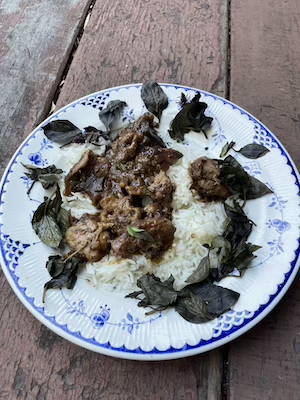
When I was a boy in British Hong Kong, dishes like this one were among the classics. Casting about the Web for a recipe, I found some very odd reinterpretations, so I thought: "I know! Let's seek one from that extremely talented local-pride HK chef Martin Yan." (Yan was for many years famous to Americans for his high-energy cooking show "Yan Can Cook" on public television.) Et voila! Here's the real thing.
This dish's bright and zesty flavour and aroma, with notes of licorice, mild pepperiness, sweetness, and pungency, comes, in significant part, from the key spice mix, "five-spice powder", found in all varieties of Chinese cooking and usually1 comprising star anise, fennel, cloves, Chinese cinnamon, and Sichuan pepper fruit2.
USA restaurant variants often do this dish heavily battered with a thick sauce, but I much prefer this marinated and lightly sauced version.
Yields:
about 8 servings
Time Required:
- 20 mins. prep. time (not counting marinating)
- 30 mins. cooking time
- 50 mins. total time
Ingredients:
- 2 lb. (0.9 kg) boneless chicken thighs3, about 4 pieces
- cooking oil, for coating the grill
Marinade
- 2 tsp.4 (4.2 g) five-spice powder
- 2 tsp. (4.2 g) ginger, minced5
- 2 tsp. (5 g) garlic, minced5
- 2 tsp. (2.4 g) red chili, minced5
- 2 tsp. (7 g) shallot6, minced5
- 2 eggs
- 4 Tbsp. (60 mL) soy sauce
- 2 Tbsp. (30 mL) Chinese rice wine7 or dry sherry
- 1 Tbsp. (15 mL) sesame oil
Sauce
- 2 tsp.(8.4 g) sugar
- 1 tsp. (2.1 g) five-spice powder
- 1 cup (225 mL) chicken stock8
- 2 Tbsp. (30 mL) dark soy sauce9
- 4 tsp. (20 mL) Chinese black vinegar or balsamic vinegar10
- 2 Tbsp. (16 g) corn starch (US/Canada), aka cornflour (UK/other)11 dissolved with 2 Tbsp. (30 mL) water
Preparation:
Combine all marinade ingredients in a large bowl. Add chicken, and toss, to coat evenly.
Light a charcoal fire in a barbecue grill. When coals are lit, and have turned white on edges, lightly oil top grate with an oil-soaked paper towel. Drain excess marinade from chicken, and place chicken pieces on grate and grill until done, about 5 mins. on each side. If using a grill pan, heat pan on medium-high heat until hot. Oil pan with a brush or oil-soaked paper towel. Place chicken on pan and grill until done, about 4-5 mins. on each side. Remove chicken, and place on a serving plate.
Combine sauce ingredients except for corn starch solution in a saucepan, and bring to a boil. Add corn starch solution, and stir until sauce thickens. Pour sauce over chicken and serve.
Author's Notes:
Trim the obvious large fat pockets from the chicken thighs, and discard. Otherwise, they will cause flare-ups on a charcoal grill.
Cook's Notes:
Equipment needed: BBQ grill with charcoal or other fuel. Grill pan (opt.). Paper towels. Tongs for handling chicken. Brush for cooking oil. Mixing bowl for marinade. Serving plate to receive cooked chicken.
My first time making this recipe, I decided to cut the chicken pieces up a bit, and use my wok instead of my outdoor grill, ignoring Martin Yan's signature cooking method — he made his reputation with outdoor grill cooking — and can report that results were still splendid.
1 Not all have the same constituent ingredients, which is fine, but means you should read labels to avoid surprises. For example, a common mix in southern China substitutes Vietnamese cinnamon (Cinnamomum loureiroi) and Mandarin orange peel for Chinese cinnamon (Cinnamomum cassia) and cloves, respectively, achieving a somewhat different flavour profile. Other variations also exist, often as regionalisms: Like India, China's a mosaic of varied cooking styles.
2 Sichuan pepper is not only totally unrelated to black pepper — which is the seed of a flowering, woody vine (Piper nigrum) native to South-east or South Asia, and one of the world's most popular spices — but likewise unrelated to chilli pepper and long pepper. All are differently spicy.
Sichuan pepper is, surprisingly enough, a reddish-brown fruit from a bush in the citrus family, and has a subtly evolving taste that starts out peppery, then shows tastes of anise and ginger, gradually becoming lemony (sour), salty, and hot.
3 Whenever a recipe calls for chicken thighs (and/or legs), and specifically not breast pieces, the concern seems to be to avoid white meat (and larger pieces) becoming dried out during cooking. I see no reason not to use whatever pieces you have, carefully avoiding overcooking. When I wok-fried this dish after cutting up the pieces I had (including some breast pieces), avoiding the dryness pitfall became all the easier, and it turned out fine.
4 Quarts, pints, cups, tablespoons, teaspoons, and fl. oz. are as defined in US Customary Units, not to be confused with differing British imperial, "legal", "coffee", Commonwealth of Nations, Canadian, Latin American, Japanese, Russian, or Dutch definitions — further proof that everyone needs the metric system.
5 Minced, never crushed. Put that garlic press away. Crushing these vegetables breaks all of the constituent cellulose-rich cells' walls and has unfortunate consequences to the food's tastes, particularly in the case of garlic, the crushed paste of which easily becomes bitter, lacking flavour nuance, and sometimes picking up a metallic aftertaste.
So, think of this as your motivation to get a nice, really sharp 8" (20 cm) chef's knife for mincing (producing 1⁄16" = 1.5 mm cuts), and a good cutting board.
6 Who keeps shallots in a home kitchen? I don't! However, they taste somewhere between garlic and sweet onion. So, onion, leeks, (more) garlic, or anything like that will do. I thought scallions aka green onions worked fine.
7 Choice of semi-dry white wine, here, isn't critical. I used Japanese rice wine with little fear of either starting a naval battle or any other adverse consequence. (I'll do better next time, Martin.)
8 Unless you happen to have chicken stock handy, you might substitute Summit Hill Foods's "Better Than Bouillon Base" paste (reconstituted with warm water). It's fairly high quality, available in large 8 oz. (227 g) jars. Flavours: roasted chicken, roasted beef, turkey, ham, and vegetable.
9 Dark soy sauce is a Chinese-cuisine specialty that's thicker, darker, richer, and less salty than other types. It is also aged longer, and is used mainly to add colour and flavour to dishes, after cooking. Gluten-free dark soy sauce appears rare in stores, but can also be found online.
In theory, one can shop for Korean "Jin-ganjang (진간장, 'dark soy sauce') – soy sauce aged for more than five years, also called jinjang (진장, 'aged soy sauce'), nongjang (농장, 'thick soy sauce'), or jingamjang (진감장, 'aged mature soy sauce')", or Chinese "Yìn yóu (蔭油)", primarily from Taiwan, "mushroom dark soy (草菇老抽 cǎogū lǎochōu)" or "thick soy sauce (醬油膏 jiàng yóu gāo)", or Japanese "Saishikomi (再仕込; 'twice-brewed')", also known as "kanro shōyu (甘露醤油; 'sweet soy sauce')" — but I've had better luck just seeking (in bottles' text) desired traits listed in the prior paragraph.
For verifying GF nature of anything, alas, reading "Ingredients" lists carefully is essential, and there is no shortcut.
10 Chinese black vinegar, also known as Chinkiang (or "Zhenjiang") vinegar, is made from cooked glutinous rice, fermented, and has a complex, umami-laden flavour profile lacking in Western vinegars. One recommended brand is Gold Plum. The fallback suggestion of balsamic vinegar works because it's also an aged, dark-colored vinegar, but otherwise isn't the same at all. Like other vinegars, it doesn't need refrigeration.
For the record, in my first use of this recipe, I had neither option, and so resorted to rice vinegar, which is really not the same. Still, the sauce was delicious.
11 "Corn starch" is powdered starch processed from the New World grain maize (from Spanish, orig. from Nahuatl), which grain the USA/Canada call "corn", unlike the rest of the English-speaking world, which reserves "corn" to mean cereal grains generically. This starch product, needed here in its customary role as a thickening agent, is called "corn starch" in the US/Canada, but "cornflour" in the UK and most other anglophone lands — not to be confused with whole maize grain: That product — not a thickening agent — is called "polenta", "corn meal", or "corn flour" in the US/Canada, depending on how finely milled, and called "maize flour" in the UK and most other places. Australians should beware that their "cornflour" is starch extracted from wheat kernel, sometimes more-helpfully labelled as "wheaten cornflour". As if that weren't confusing enough, the maize-based thickener may be labelled (in Australia) either as "corn flour" or as "corn starch", so beware. Further, the maize flour product, there, is labelled as "cornmeal".
Note that whole-maize grain is traditionally, in Meso-American cultures of origin, wisely soaked in alkaline solution ("nixtamalised") to increase bioavailability and thereby prevent niacin deficiency (pellagra), among other important benefits, yielding "masa" (lit. dough) aka "masa de maíz" (lit. maize dough), also available in dried & ground form as "masa harina" (lit. dough flour) aka "harina de maíz" (lit. maize flour), and in its unground form, hominy. As further complication, Americans distinguish "corn flour", meaning prepared from maize endosperm only, from "maize flour" for use of whole maize — the former, neutral-flavoured; the latter, much more nutritious.
Origin of the naming mess: Originally, North America shared with Mother England the language's original meaning of "corn" to mean cereal grains generically (from Old English "corn" meaning single seed of any cereal plant, orig. from Proto-Germanic "kurnam" meaning small seed). The colonists got the gift of maize from native peoples, therefore at first calling it "Indian corn". Later, in the USA and Canada, "Indian corn" got worn down to just "corn", while the original meaning of "corn" was lost, locally. "Maize" is thus now the least-ambiguous term in international contexts, though many Americans either don't know that word or reserve it for variants from Latin-American (and Spanish) cooking.
Taken from: https://yancancook.com/home/recipe/five-flavor-grilled-chicken/, as Martin Yan's recipe, also included in his 2001 cookbook Blissful Cooking (Innoform Media, Ltd., Singapore). Thank you!
Collected and re-published at http://linuxmafia.com/~rick/recipes/five-flavour-chicken.html by Rick Moen <rick@linuxmafia.com> on July 15, 2026. Individual recipes are free from copyright. Share and enjoy!
(If I have any copyright title in my own very minor contributions to this page — not my intention — they were created in 2026 by Rick Moen <rick@linuxmafia.com> and licensed for use under CC0. The image file (photograph) was taken on July 23, 2026, also by Rick Moen <rick@linuxmafia.com> and licensed for use under CC0. I have thereby waived all copyright, compilation copyright, and related or neighbouring rights to this work. This work is published from: United States of America.)